Whole Nematode Brain Calcium Imaging
Prof. Vivek Venkatachalam
Department of Physics, Northeastern University, Boston, USA
Background
The research focus of Professor Vivek Venkatachalam and his team is whole brain activity in the nematode C. elegans. Prof. Venkatachalam told us more, “We aim to understand how brain activity is related to short- and long-range connections that allow neurons to communicate with each other, and also the internal structure and gene expression of cells.”
“We mostly focus on the functional activity of these cells, and for this we have a custom confocal microscope that can image between 3-10 brain volumes per second reliably over long timescales, to look at how the worm’s brain responds to many relevant stimuli. We use food, pheromones, aversive stimuli, and attractive stimuli, to activate the brain in different ways and compare them to see how the animal is processing information. We can do this for worms of different sexes and life stages to understand how different brains work.”

Figure 1: Image of an entire C. elegans brain taken with the Kinetix sCMOS camera, showing individual cells with a GCaMP stain.
Challenge
Prof. Venkatachalam described the imaging challenges he and his team face in their application, “We want to focus on the sensitivity and efficiency of our whole microscope and imaging system. Worms don’t love the blue light required to image with GCaMP. To avoid bleaching and phototoxicity, we want to keep the laser illumination power very low while still maintaining good detection.”
“We also need to identify all the cells in these animal brains to compare activity between animals. While two mice or humans don’t have the exact same neurons and can’t be compared in that way, with C. elegans it’s a precisely defined lineage, every animal develops in the exact same way, has the same number of cells in the same place. So, we express a fluorescent barcode developed by collaborators in every cell that allows us to compare between animals, a method called NeuroPAL. But to image this, we need cameras that can efficiently capture deeper into the blue and red for fluorophores like BFP or mNeptune, as these can be challenging to get good signals from.”
Prof. Venkatachalam requires a camera that is highly sensitive across a wide wavelength range and features a large field of view (FOV).
The Kinetix is very valuable for this project, it’s increased our imaging duration and improved our ability to get good neuron identification, with overall higher sensitivity than previous CMOS cameras.
Prof. Vivek Venkatachalam
Solution
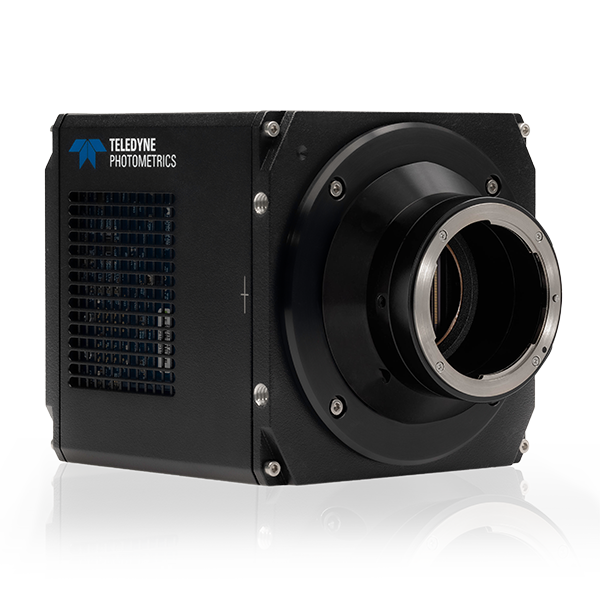
The Kinetix is an ideal solution for this application, as outlined by Prof. Venkatachalam, “We use two Kinetix cameras, one imaging a red reference and one imaging dynamic green GCaMP. We are imaging fluorophores localised to cell nuclei, only a couple of microns across, and resolving these is definitely one of the values of the Kinetix. We swapped out some other CMOS cameras for the Kinetix and we’re now easily able to image these colour stacks at lower laser power.”
“Now we have a beautiful map of how every neuron responds differently, which is really cool. It should be clear how the Kinetix is very valuable for this project, it’s increased our imaging duration and improved our ability to get good neuron identification. The Kinetix has overall higher sensitivity and greater sensitivity in the far blue and far red than what we had with our previous CMOS.”
“The speed is also something we care about; we wanted something that could operate very fast in order to image volumes through the animal brain and to synchronise with our spinning disk… We have programmed this all in C, the PVCAM SDKs are good and use good examples.”