SWIR MCT Focal Plane Arrays
Henry Yuan, Jiawen Zhang, Jongwoo Kim, Carl Meyer, Joyce Laquindanum, Joe Kimchi, JihFen Lei
Teledyne Judson Technologies
Background
Teledyne Judson Technologies (TJT) has developed high-performance short-wavelength infrared (SWIR) HgCdTe (MCT) focal plane arrays (FPAs) with 320×256 pixels and 30 µm pitch, now in production for commercial, space, and military applications. SWIR FPAs with cutoff wavelengths of 2.5 µm and 2.9 µm are particularly suited for thermal imaging, remote sensing, and low-light astronomy. MCT remains the preferred material for these applications due to its superior quantum efficiency (QE), low dark current, and flexible epitaxial growth options compared with InGaAs or III-V strained-layer superlattice materials.
Challenge
Developing SWIR FPAs that operate over a wide temperature range, from near room temperature to cryogenic levels, while maintaining low dark current, high operability, and uniform performance is challenging. Mesa etching, hybridization, and anti-reflection (AR) coating must be carefully controlled for both molecular beam epitaxy (MBE) and liquid phase epitaxy (LPE) MCT wafers. Additionally, FPAs must perform under varying field-of-view (FOV) conditions and be compatible with multiple package types, including thermo-electrically cooled and LN2-cooled dewar packages.
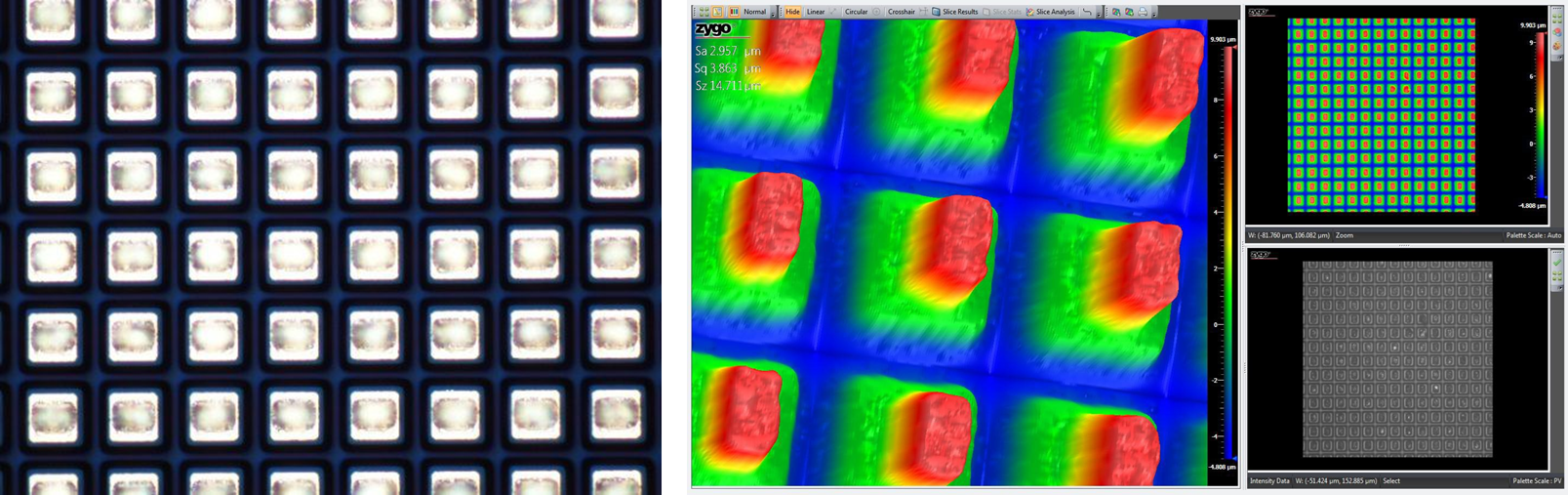
Figure 1: Images of the MCT FPA. Left) top view microphotograph of a 320x256 array of 30 µm pixels with In-bumps. Mid+Right) Zygo profilometer test results on the In-bump arrays.
Solution
TJT fabricated detector arrays on CdZnTe substrates using MBE as the primary growth method, with LPE used for historical or specialized devices. MBE offers low background carrier concentration, precise thickness control, and uniform cutoff wavelength across the wafer. Both MBE and LPE arrays were fabricated with a P-on-n mesa structure and 30 µm pixel pitch.
Arrays were hybridized to FLIR ISC9809 Si ROICs using indium bump flip-chip bonding. ROICs employ capacitive trans-impedance amplifier (CTIA) inputs with two gain settings: 210 fF for low gain and 10 fF for high gain. Backside illumination was achieved with a single-layer AR coating applied to the polished CZT substrate. FPAs were packaged in various configurations, including 84-pin leadless chip carriers (LCC), MC-50 with four-stage TEC, 34-pin dual in-line packages (P34DIP), and closed-cycle cooler (CCC) dewars with RICOR micro-coolers.
Comprehensive characterization included spectral responsivity, QE, dark current, noise equivalent irradiance (NEI), pixel operability, bad pixel mapping, and IR imaging under controlled temperature and FOV conditions. Performance evaluation chips (PECs) on the same wafer were used to assess uniformity and QE.
Results
For 2.5 µm cutoff MBE FPAs, typical dark current per pixel was 275 pA at room temperature and 195 fA at -70 °C with a 100° FOV. NEI at -70 °C was 1.88×10⁹ photons cm⁻² s⁻¹, limited primarily by background photocurrent. Spectral responsivity peaked above 1.3 A W⁻¹ at 2.25 µm, and peak QE exceeded 85% between 1.3-1.6 µm. Operability reached 99.95%, with no bad pixel clustering. Reliability tests, including 136 h vacuum baking at 80 °C, showed negligible changes in dark current, non-uniformity, or bad pixel count, confirming robustness for TEC or dewar packaging.
For 2.9 µm cutoff MBE FPAs, pixel dark current ranged from 372 pA at room temperature to 487 fA at -70 °C, and typical NEI was 3.38×10⁹ photons cm⁻² s⁻¹. Peak spectral responsivity reached 1.45-1.5 A W⁻¹ around 2.5-2.7 µm, with QE above 80% from 1.1-2.1 µm. Operability remained high at 99.89% with no clustering. As with 2.5 µm FPAs, background photocurrent dominated NEI at low temperatures, and reducing FOV or operating at moderately higher temperatures minimally impacted performance. Pixel capacitance at 100–200 mV reverse bias ranged from 100-300 fF at room temperature.
IR imaging demonstrated clear reflective and thermal images at -70 °C for both 2.5 µm and 2.9 µm FPAs, confirming uniformity, low noise, and high QE.
Conclusion
TJT has successfully developed and put into production high-performance SWIR MCT 320×256/30 µm FPAs with 2.5 µm and 2.9 µm cutoff wavelengths. The arrays achieve ultra-high operability (~99.9%), peak QE ~85%, low dark current, and NEI limited primarily by background photocurrent at cryogenic temperatures. MBE growth, P-on-n mesa fabrication, indium bump hybridization, and AR coating enable high uniformity and reliability. The FPAs’ ability to operate at higher temperatures with minimal performance degradation, combined with versatile packaging options, makes them suitable for commercial space, industrial, and scientific applications.
Read the original published article here:
High performance SWIR HgCdTe 320x256/30μm FPAs at Teledyne Judson Technologies
Henry Yuan, Jiawen Zhang, Jongwoo Kim, Carl Meyer, Joyce Laquindanum, Joe Kimchi, JihFen Lei
Abstract
High performance short-wavelength infrared (SWIR) HgCdTe focal plane arrays (FPAs) of 320x256/30μm have been well developed and are now in production at Teledyne Judson Technologies (TJT). These FPAs have two cutoff wavelengths, 2.5μm and 2.9μm in general, and can operate over a wide temperature range. The detector arrays were fabricated primarily with molecular beam epitaxy (MBE) HgCdTe materials, although liquid phase epitaxy (LPE) materials were also used, both materials on CdZnTe substrates. These FPAs use ISC 9809 Si readout integrated circuit (ROIC) and have excellent operability, low dark current, high quantum efficiency (QE), good uniformity and high yield. Comprehensive characterization of FPA performance was performed from room temperature to LN2, and the test results are presented and discussed in this paper. Typical operability is ~99.9%, and peak QE ~85%. FPA noise is background limited at -70°C with field-of-view (FOV) ~100° and becomes lab camera electronics limited when FOV ~0°. Pixel dark current either matches or is below the values from Rule-07 model over a wide temperature range. Noise equivalent irradiance (NEI) of 2-3E9 Ph/cm2-s is achieved at -70°C and could be further reduced under smaller FOV.
Reference
Henry Yuan, Jiawen Zhang, Jongwoo Kim, Carl Meyer, Joyce Laquindanum, Joe Kimchi, and JihFen Lei (26 September 2018) High performance SWIR HgCdTe 320x256/30μm FPAs at Teledyne Judson Technologies, Proc. SPIE 10766, Infrared Sensors, Devices, and Applications VIII, 107660J; https://doi.org/10.1117/12.2501430