Novel light-sheet FCS-SOFI
Prof. Lydia Kisley, Dr Stephanie Kramer
Department of Physics and Chemistry, Case Western Reserve University, OH, USA
Background
The research interests of Ambrose Swasey Associate Professor Lydia Kisley are at the interface of physics and chemistry, also incorporating biology and materials science. Prof. Kisley explained some of her recent research, “One of our projects is focused on the extracellular matrix, where we are taking a bottom-up approach. We’ve cultured cells into collagen gels and are aiming to see how fluorescent molecules or proteins diffuse in this environment, and how the cells modify this environment.”
“Our approach is unique in that we’re looking at diffusion within the void spaces of the extracellular environment, and that diffusion is fast. With super-resolution techniques our goal is 100 nm resolution using correlation approaches. We anticipate that as cells deposit materials and modify the environment around them, they will limit diffusion speeds, but this speed will increase in the void between cells.”
“Our imaging is essentially fluorescence correlation spectroscopy (FCS) combined with super-resolution optical fluctuation imaging (SOFI). While FCS is traditionally diffraction-limited, SOFI captures super resolution spatial information across a wide field of view. We also use light-sheet illumination, so our illumination and detection pathways are quite novel.”
For more information, please refer to the recent publication by Kramer et al. 2024 linked below.

Figure 1: 3D reconstruction with deconvolution of A) stationary 2 µm beads and B) dynamic 155 kDa dextran in a 2 wt. % agarose gel generated using 3D reconstruction code from data collected on the home-built light-sheet microscope, obtained using the Kinetix22 sCMOS camera. Image from (Kramer et al. 2024).
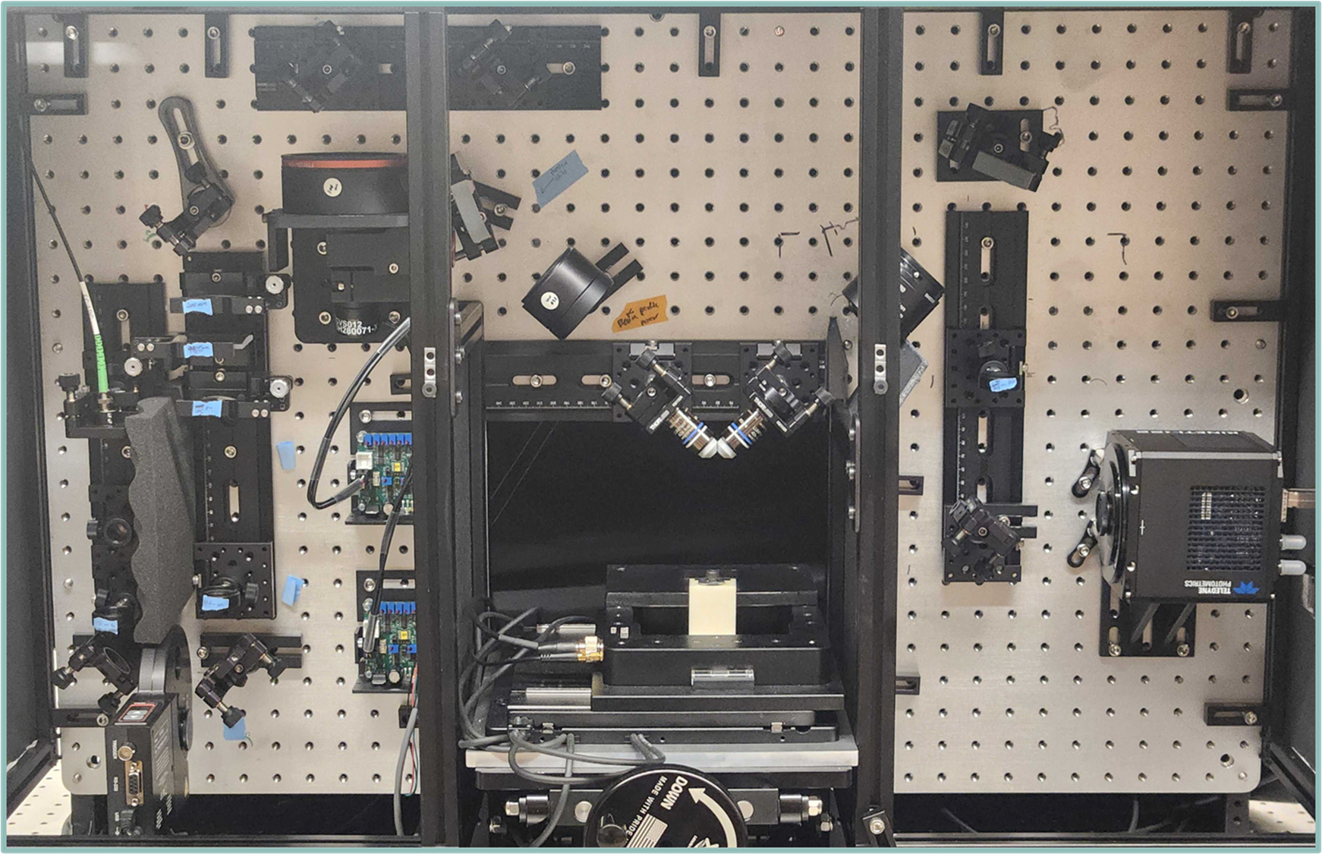
Figure 2: The optical setup and light path for FCS-SOFI with dual-inverted light-sheet illumination. This breadboard is mounted at 90 degrees in order to shorten the light path. The illumination pathway is on the left, and the detection pathway (showing the Kinetix22) is on the right.
Challenge
This combination of techniques designed to image fast, dynamic samples present a number of interesting imaging challenges, as Prof. Kisley outlines, “We are hypothesising diffusion rates in the extracellular environment in the 10s of micrometres square per second, and that’s not easy to capture with single molecule tracking. We have to capture this fast diffusion on a reasonable length scale, with more conventional cameras images appear blurred over 10 pixels or so. Also, because diffusion is fast and the frame rates are high, the exposure times and signal levels are very low, only 30 photos above background.”
I also spoke to lecturer and collaborator Dr. Stephanie Kramer, “We have unique mounting geometry where the breadboard is at 90°, partially due to our inverted light sheet illumination. We are using two different objectives for illumination and detection, and we still want to image biological samples. This provides gentle illumination to decrease photobleaching or phototoxicity across the entire sample, as well as 3D slicing capabilities.”
Our approach is unique in that the diffusion in the extracellular environment is very fast, and that’s where the Kinetix22 is critical, we are seeing really good results.
Prof. Lydia Kisley
Solution
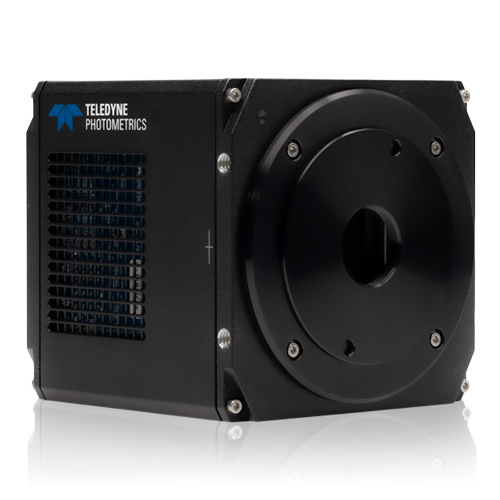
The Kinetix22 sCMOS camera is an ideal solution for this unique application, providing extreme imaging speeds and high sensitivity across a large field of view. Prof. Kisley told us about her experience with the Kinetix22, “We need to capture on the millisecond timescale to observe fast diffusion, that’s why we looked into the Kinetix and purchased the Kinetix22. It can run at over 10,000 frames per second, with that we’re seeing really good data with these fast-diffusing events.”
“The Kinetix22 has been really nice in terms of the high frame rate and the high quantum efficiency, so we can get enough photons for our correlation techniques and gather information about diffusion within the extracellular environment. Even at our high magnifications, we can also capture across a wide field of view with the Kinetix22.”
Reference
Stephanie N. Kramer, Jeanpun Antarasen, Cole R. Reinholt and Lydia Kisley (2024) A practical guide to light-sheet microscopy for nanoscale imaging: Looking beyond the cell, J. Appl. Phys. 7 September; 136 (9): 091101. https://doi.org/10.1063/5.0218262