High Operating Temperature MWIR Photodetectors
Jongwoo Kim, Henry Yuan, Andrey Rumyantsev, Phillip Bey, David Bond, Joe Kimchi, Mary Grace DeForest
Teledyne Judson Technologies
Background
Mid-wavelength infrared (MWIR) photodetectors are widely used in applications such as thermal imaging, chemical sensing, and medical diagnostics. Traditionally, mercury cadmium telluride (HgCdTe, MCT) has been the dominant material for MWIR detection due to its high quantum efficiency and low dark current. However, type-II superlattice (T2SL) materials, particularly InAs/InGaSb, have emerged as a promising alternative owing to their tunable bandgap, suppressed Auger recombination, and reduced tunneling currents. These properties enable potentially longer carrier lifetimes, lower dark current, and operation at higher temperatures. Despite these advantages, InAs/InGaSb T2SL detectors often fail to achieve predicted performance due to challenges in material growth, device fabrication, and surface passivation. Recent research has focused on Ga-free InAs/InAsSb T2SLs, which exhibit longer carrier lifetimes than their InAs/InGaSb counterparts and show potential for high operating temperature MWIR detection.
Challenge
The primary challenge addressed in this work is the development of high operating temperature MWIR photodetectors that can operate effectively at or near room temperature while maintaining high optical performance. Specifically, the detectors must exhibit high responsivity, high quantum efficiency, low dark current, and high detectivity. Additionally, the fabrication process must be compatible with large-area, scalable, and low-cost production. Achieving low dark current is particularly challenging because, at high temperatures, it is dominated by diffusion mechanisms, whereas at lower temperatures, tunneling and surface leakage currents prevail. Maintaining uniform optical response over the active area while minimizing surface leakage and contact resistance further complicates device design.
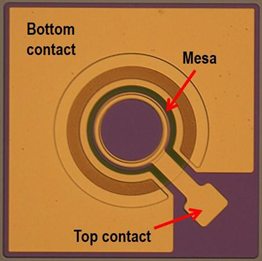
Figure 1: Photo of a completed front-illuminated InAs/InAsSb T2SL detector.
Solution
To address these challenges, large-area discrete InAs/InAsSb T2SL detectors with diameters of 0.25 mm and 1 mm were designed and fabricated for front-side illumination. The device structure consists of an n-type doped top T2SL contact layer, an electron barrier, an undoped InAs/InAsSb absorber layer, and an n-type doped bottom contact layer on an n-type GaSb substrate. All T2SL layers were composed of equal numbers of monolayers of InAs and InAsSb. The wafers were grown by molecular beam epitaxy and characterized using high-resolution X-ray diffraction and photoluminescence measurements, confirming high structural quality and the desired strain properties.
A quasi-planar fabrication process was employed to enable simplified, low-cost production. Mesas were wet-etched, stopping at the top of the barrier layer. Sidewalls were passivated with a low-temperature plasma-enhanced chemical vapor deposited SiO₂ layer. Contact windows were opened using wet etching, followed by deposition of an antireflection coating and metal contacts. The electrical and optical properties were characterized through current-voltage and spectral response measurements over temperatures ranging from 208 K to 295 K.
The 1 mm detectors achieved a 50% cutoff wavelength of approximately 5.5 μm at 295 K, a peak responsivity of 2.47 A/W at 4.24 μm and -0.3 V bias, and a corresponding quantum efficiency of 72% with an antireflection coating. The dark current density was as low as 1.17 A/cm² at -0.3 V and 295 K, and the specific detectivity reached 1.93 × 10⁹ cm·√Hz/W. The dark current was diffusion-limited above approximately 120 K, while tunneling and surface leakage dominated at lower temperatures. The smaller 0.25 mm detectors exhibited similar performance, with a peak responsivity of 2.05 A/W, a quantum efficiency of 60%, and a dark current density of 1.34 A/cm² at 295 K. Noise measurements indicated low 1/f noise, with the output dominated by shot noise, and spatial uniformity measurements showed non-uniformity below 5% for the 0.25 mm detectors and below 8% for the 1 mm detectors.
Conclusion
In summary, high-performance MWIR InAs/InAsSb T2SL discrete photodetectors have been successfully developed and characterized. The devices demonstrate high responsivity, high quantum efficiency, low dark current, and good spatial uniformity at room temperature, approaching the performance of conventional HgCdTe photodiodes. The quasi-planar fabrication process supports low-cost, scalable production, making these detectors suitable for applications requiring near-room-temperature MWIR detection. Further reductions in dark current can be achieved through optimization of device structure and fabrication techniques, solidifying InAs/InAsSb T2SL detectors as promising candidates for military, industrial, and medical infrared imaging systems.
Read the original published articles here:
HOT MWIR InAs/InAsSb T2SL discrete photodetector development
Jongwoo Kim, Henry Yuan, Joe Kimchi, JihFen Lei, Elizabeth Rangel, Peter Dreiske, Amal Ikhlassi
Abstract
Teledyne Judson Technologies (TJT) has developed high operating temperature (HOT) mid-wavelength infrared (MWIR) photodetectors based on InAs/InAsSb type-II superlattice (T2SL) with an electron barrier. Large area discrete detectors of 0.25mm and 1mm diameters were designed and fabricated for front-side illumination. Comprehensive E-O characterization was performed at room temperature and thermo-electric cooled (TEC) temperatures. The unique fabrication process was developed for a quasi-planar structure, enabling simplified fabrication for low-cost large volume production. The detector shows a 50% cut-off wavelength of ~5.5μm at room temperature. Peak responsivity of 2.47 A/W was achieved on 1mm detectors at peak wavelength ~ 4.24μm, -0.3V bias and 295K. Peak quantum efficiency (QE) was 72% with an antireflection coating. The 1mm detectors showed peak detectivity (D*) of 1.9x109 cm-√Hz/W at -0.3V bias, 295K and 10 kHz. Dark current density as low as 1.17 A/cm2 was achieved at -0.3V bias and 295K on 1mm detectors. The dark current was diffusion-limited at higher temperatures above ~120K while it was dominated by either tunneling or surface leakage currents at lower temperatures. Similar results were obtained on 0.25mm detectors.
Reference
Jongwoo Kim, Henry Yuan, Joe Kimchi, JihFen Lei, Elizabeth Rangel, Peter Dreiske, and Amal Ikhlassi (15 May 2018) HOT MWIR InAs/InAsSb T2SL discrete photodetector development, Proc. SPIE 10624, Infrared Technology and Applications XLIV, 1062412; https://doi.org/10.1117/12.2303973
Characterization of HOT MWIR InAs/InAsSb T2SL discrete photodetectors
Jongwoo Kim, Henry Yuan, Andrey Rumyantsev, Phillip Bey, David Bond, Joe Kimchi, Mary Grace DeForest
Abstract
A comprehensive study of mid-wavelength infrared (MWIR) InAs/InAsSb type-II superlattice (T2SL) photodetectors was performed for full characterization of the E-O performance, reliability, and linearity as well as response speed. Teledyne Judson Technologies has recently developed high operating temperature (HOT) MWIR InAs/InAsSb T2SL large area discrete detectors of 0.25mm and 1mm for front-side illumination. The 50% cut-off wavelength of the detectors ranges from ~5.4 to ~5.7μm at room temperature. For the reliability tests, the T2SL detectors were thermally cycled and humidity tested. Initial testing data showed excellent stability to the temperature and humidity, indicating the T2SL detectors have long-term stability. Linearity, response speed and capacitance were measured at various temperatures and reverse biases. This work presents comprehensive test results, data analysis, and discussion, showing these large size, discrete T2SL detectors have the potential to replace conventional MWIR detector materials.
Reference
Jongwoo Kim, Henry Yuan, Andrey Rumyantsev, Phillip Bey, David Bond, Joe Kimchi, and Mary Grace DeForest (3 March 2020) Characterization of HOT MWIR InAs/InAsSb T2SL discrete photodetectors, Proc. SPIE 11276, Optical Components and Materials XVII, 112760J; https://doi.org/10.1117/12.2553686