FPA Development: From InGaAs to InSb to MCT
Henry Yuan, Gary Apgar, Jongwoo Kim, Joyce Laquindanum, Varsha Nalavade, Paul Beer, Joe Kimchi, Ted Wong
Teledyne Judson Technologies
Background
Infrared focal plane arrays (FPAs) are the core sensing elements in advanced imaging systems, enabling detection from the visible spectrum through the long-wave infrared. Selecting the right detector material and device architecture is essential for achieving the low noise, high sensitivity, and reliability required in scientific, industrial, and defense imaging applications.
Building on decades of expertise in infrared detector design and fabrication, Teledyne Judson Technologies (TJT) is advancing the state of the art in 2D FPAs using InGaAs, InSb, and MCT (HgCdTe, mercury cadmium telluride). These complementary material systems enable high-performance imaging across the entire infrared spectrum, from the visible and near-infrared (NIR) through the short-wave (SWIR), mid-wave (MWIR), and long-wave (LWIR) infrared bands.
Challenge
Next-generation imaging systems must overcome several key technical challenges. One is the need for broad spectral coverage, many applications require operation across multiple wavelength bands, yet no single detector material is naturally sensitive to the entire range. Another challenge is temperature dependence. Low dark current and noise are essential for high sensitivity, but these typically require deep cooling, increasing system size, complexity, and power demands.
At the same time, there is continuous demand for higher resolution and smaller pixel pitches without compromising sensitivity or uniformity, placing significant constraints on device design and fabrication processes. Finally, detectors must achieve low noise and high operability, maintaining excellent uniformity, low noise-equivalent irradiance (NEI), and noise-equivalent temperature difference (NETD) across the entire array to support demanding scientific and industrial applications.
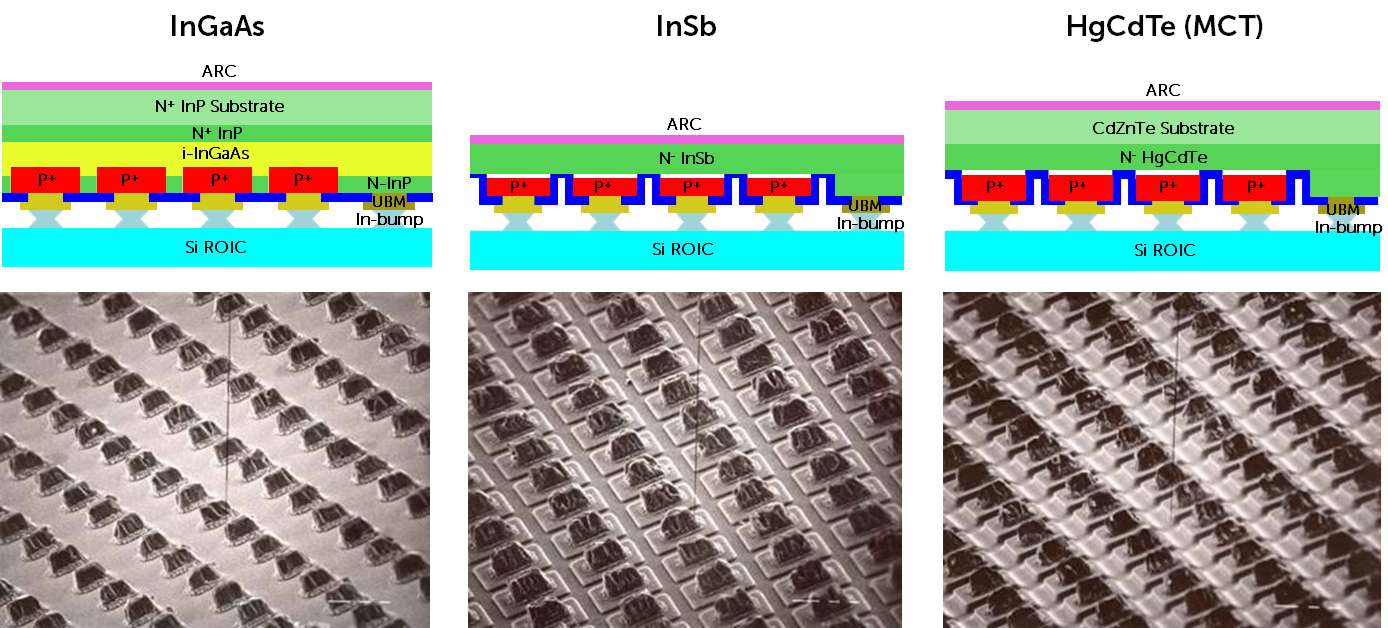
Figure 1: Cross-sections (above) and SEM images (below) comparing InGaAs, InSb and MCT FPA structures, complete with In-bumps.
Solution
TJT addresses these challenges through a comprehensive FPA development program that integrates advanced materials engineering, optimized device architectures, and refined fabrication processes. By tailoring each detector platform to its specific spectral range, we deliver high-performance solutions that meet or exceed the stringent requirements of modern imaging systems.
InGaAs technology remains a cornerstone for SWIR detection. Standard 1.7 µm InGaAs FPAs provide excellent room-temperature performance with mean dark currents as low as 70 fA and operability exceeding 99.8%, while maintaining low NEI. A visible-extended variant, VisGaAs, incorporates additional design modifications to extend sensitivity below 0.9 µm, achieving quantum efficiency above 40% in the visible range while retaining over 80% QE in the near-infrared. Extended-wavelength InGaAs devices push the cutoff to 2.6 µm, expanding coverage deeper into the SWIR band and enabling applications that demand longer-wavelength sensitivity.
For mid-wave infrared detection, InSb FPAs continue to deliver exceptional performance. Arrays fabricated on low-doped bulk material achieve NETD values as low as 14.6 mK at liquid nitrogen temperatures, making them ideal for thermal imaging, spectroscopy, and low-background detection.
MCT technology offers the broadest spectral tunability, enabling optimized performance from the SWIR through the LWIR. Our 5 µm-cutoff MWIR MCT arrays demonstrate high quantum efficiency of 70-80% even without antireflection coatings and achieve NETD values around 51 mK at -70 °C. This combination of sensitivity, spectral coverage, and thermal performance makes MCT the preferred material for the most demanding applications, from defense imaging to scientific instrumentation.
|
Material |
Band Coverage |
Operating Temp. |
Performance Metrics |
|
InGaAs |
0.9-1.7 µm |
Room temp |
NEI ≈ 2.6×10⁹ ph/cm²/s Operability >99.8% |
|
VisGaAs |
0.4-1.7 µm |
Room temp |
Dual-band visible/SWIR imaging |
|
InSb |
3-5 µm |
77 K (LN₂) |
NETD ≈ 14.6 mK |
|
MCT |
0.8-12 µm |
-70 °C to LN₂ |
NETD ≈ 51 mK |
Future Directions
TJT continues to expand the capabilities of its infrared FPA portfolio. Ongoing work focuses on scaling to larger formats, such as 1280×1024 arrays with 20 µm pixel pitch, and on the development of next-generation readout integrated circuits optimized for ultra-low noise and high frame rates. Improvements to substrate removal and buffer engineering techniques are also underway, further broadening spectral response and reducing parasitic absorption to enhance overall detector performance.
Conclusion
Through innovation in materials, architecture, and process technology, TJT has established a comprehensive suite of FPA solutions that deliver low noise, high sensitivity, and wide spectral coverage. From room-temperature InGaAs detectors to cryogenically cooled MCT arrays, these devices enable the high-performance imaging capabilities demanded by today’s scientific, industrial, and defense applications.
Our ongoing research and development efforts ensure that these capabilities will continue to evolve, providing the precision, flexibility, and performance needed for the next generation of infrared imaging systems.
Read the original published article here:
FPA development: from InGaAs, InSb, to HgCdTe
Henry Yuan, Gary Apgar, Jongwoo Kim, Joyce Laquindanum, Varsha Nalavade, Paul Beer, Joe Kimchi, Ted Wong
Abstract
This paper reports preliminary results obtained on 1.7µm InGaAs, Vis-InGaAs, extended-wavelength InGaAs, InSb, and HgCdTe 320x256 FPAs fabricated at Judson. Test structures designed to characterize fundamental detector parameters are presented. FPA performance and imaging analysis are reported. Possible performance improvements by means of architectural design and fabrication process refinement are described. Future development plan and preliminary experimental results on FPAs with larger format and smaller pitch are also discussed. Relatively low dark current and NEI values, as well as high operability, are achieved for 1.7µm InGaAs FPAs at room temperature. High quantum efficiency in the visible wavelength range is achieved for Vis-InGaAs FPAs. Low NETD values are achieved for InSb FPAs at LN2 and MWIR HgCdTe FPAs at -70°C (203°K).
Reference
Henry Yuan, Gary Apgar, Jongwoo Kim, Joyce Laquindanum, Varsha Nalavade, Paul Beer, Joe Kimchi, and Ted Wong (1 May 2008) FPA development: from InGaAs, InSb, to HgCdTe, Proc. SPIE 6940, Infrared Technology and Applications XXXIV, 69403C; https://doi.org/10.1117/12.782735