High Performance VLWIR MCT Detectors
Henry Yuan, Kelly Bartholomew, Devon Myers, Carl Meyer, Angela Russell, Joyce Laquindanum, Ravi Guntupalli, Bo Shojaei, Christopher Chen, Shumin Wang, Bill Conroy, Aristo Yulius, Michael Carmody
Teledyne Judson Technologies
Background
Very long wavelength infrared (VLWIR) photoconductive (PC) detectors based on mercury cadmium telluride (HgCdTe or MCT) are essential for demanding applications such as Fourier-transform infrared (FTIR) spectroscopy, space instrumentation, and scientific sensing. Compared with photovoltaic detectors, photoconductive MCT devices offer lower cost, simpler fabrication, and straightforward scalability to longer wavelengths beyond 14 µm and even into the far-infrared. For decades, these detectors relied on bulk-grown MCT wafers, but supply constraints and material limitations have made this approach increasingly unsustainable. Meanwhile, epitaxial growth techniques have advanced significantly, with molecular beam epitaxy (MBE) emerging as a promising route for next-generation VLWIR photoconductors.
Challenge
Bulk MCT wafers, once the backbone of photoconductive detector production, are no longer widely available, and their performance characteristics present significant limitations for advanced VLWIR devices. Bulk-grown materials often suffer from smaller wafer sizes, poorer uniformity, and higher defect densities, which translate into reduced detectivity, higher noise, less precise spectral control, and pronounced channeling effects. These shortcomings reduce yield, complicate manufacturing, and limit the performance of discrete detectors and arrays. As the demand for high-performance VLWIR devices grows, a scalable, high-uniformity material solution is needed to replace bulk wafers without compromising, and ideally improving, detector performance.
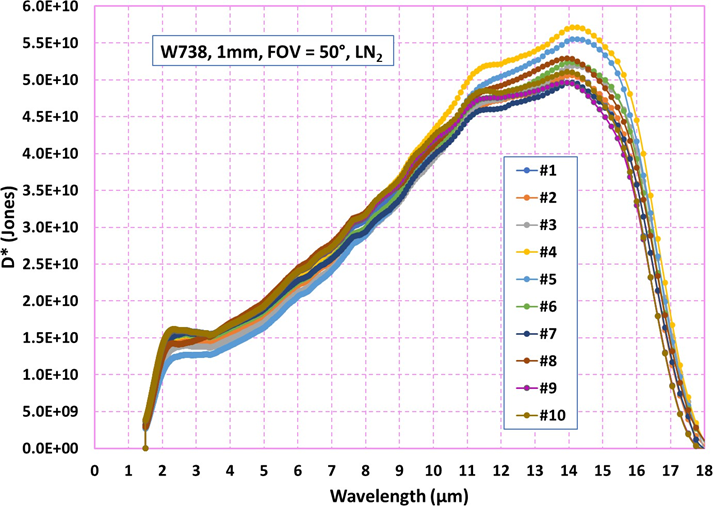
Figure 1: Spectral D* plots measured from qty 10 of 1 mm detectors covering the entire wafer #738 at LN2 and with FOV=50°.
Solution
Teledyne Judson Technologies (TJT), in collaboration with Teledyne Imaging Sensors (TIS), has developed high-performance VLWIR photoconductive detectors based on MBE-grown MCT on lattice-matched CdZnTe substrates. This approach enables wafer sizes of up to 6 cm × 6 cm, offering a substantial increase over the typical 15 mm diameter of bulk wafers and simplifying downstream fabrication by removing the need for substrate removal, wafer thinning, or backside processing. MBE growth also provides superior material quality with low defect densities and excellent doping control, resulting in improved spectral uniformity and self-passivation at the substrate interface.
The fabrication process for MBE-based detectors closely matches that used for bulk devices but benefits from higher consistency and a reduced number of steps. Detectors with cutoff wavelengths near 17 µm at liquid nitrogen temperature (77 K) have been developed and fully qualified for production in both 1 mm and 0.25 mm formats. These detectors demonstrate improved detectivity, lower noise, reduced channeling, and more precise spectral control, addressing the critical limitations of bulk-based devices.
Results
Extensive performance evaluations comparing MBE-based detectors to those made from bulk wafers show consistent and significant improvements across all key parameters. For 1 mm devices, average detectivity increased by around 25-30 % at 10 kHz and 1 kHz, while 0.25 mm detectors showed gains of approximately 35-38 %. Peak responsivity improved by 29-47 % depending on detector size.
Spectral characteristics also showed marked enhancement. Cutoff wavelength uniformity improved substantially, with MBE detectors achieving a mean cutoff of 17.0 µm with nearly half the variation of bulk detectors. Spectral channeling (a key performance parameter in FTIR applications) was reduced by 46-56 %, with most MBE devices exhibiting channeling below 2 %, compared with 5-10 % for bulk devices. None of the MBE detectors exceeded 6 % channeling, whereas many bulk-based devices did.
Noise performance followed the same trend. Variation in detectivity between 10 kHz and 1 kHz (an indicator of 1/f noise) decreased by approximately 25-30 %, confirming that MBE material exhibits fewer defects and better surface passivation. Spatial response uniformity was also improved, and bias dependence tests showed that optimal operating conditions could be achieved with minimal trade-offs in performance.
Conclusion
The transition from bulk-grown wafers to MBE-grown MCT represents a pivotal advancement in the development of VLWIR photoconductive detectors. TJT’s new generation of MBE-based devices achieves superior detectivity, higher responsivity, smoother spectral response, improved cutoff precision, and lower noise, all while enabling larger wafer sizes and higher production scalability. These improvements not only overcome the supply and performance limitations of bulk wafers but also deliver significant performance gains, with up to 38 % higher detectivity and more than 50 % reduction in channeling. The results demonstrate that MBE technology is not only a viable replacement for bulk material - it is a clear step forward, enabling the next generation of high-performance VLWIR detectors for spectroscopy, space, and advanced sensing applications.
Read the original published article here:
High-performance VLWIR MBE HgCdTe photoconductive detectors
Henry Yuan, Kelly Bartholomew, Devon Myers, Carl Meyer, Angela Russell, Joyce Laquindanum, Ravi Guntupalli, Bo Shojaei, Christopher Chen, Shumin Wang, Bill Conroy, Aristo Yulius, Michael Carmody
Abstract
Bulk grown wafers had been used for fabricating photoconductive (PC) HgCdTe detectors for several decades until recent years. As bulk wafers are getting gradually depleted over years, epitaxial grown HgCdTe wafers are becoming the only choices available. This paper reports the very long wavelength Infrared (VLWIR) PC HgCdTe detector development (cutoff wavelength ~ 17μm at LN2) at Teledyne, leveraging the state-of-the-art molecular beam epitaxy (MBE) material technology on CdZnTe substrates. These MBE wafers provide much larger wafer sizes, better uniformity, and in general better detector performance than conventional bulk wafers. Detailed detector performance comparison was performed between MBE and bulk wafers on detectivity (D*), responsivity, spectral response, etc. for 1mm and 0.25mm discrete detectors. The VLWIR MBE PC HgCdTe detectors are now in volume production at Teledyne.
Reference
Henry Yuan, Kelly Bartholomew, Devon Myers, Carl Meyer, Angela Russell, Joyce Laquindanum, Ravi Guntupalli, Bo Shojaei, Christopher Chen, Shumin Wang, Bill Conroy, Aristo Yulius, and Michael Carmody (7 June 2024) High-performance VLWIR MBE HgCdTe photoconductive detectors, Proc. SPIE 13046, Infrared Technology and Applications L, 130461C; https://doi.org/10.1117/12.3018523