Monkey Brain Calcium Imaging
Prof. Cody Siciliano
Department of Pharmacology, Vanderbilt School of Medicine, TN, US
Background
The lab of Prof. Cody Siciliano works to develop animal models and determine the neural basis of motivation, addiction, and decision making. Prof. Siciliano told us more, “Our main interest is in motivated behaviours and their dysregulation, so we look at addiction, mostly for cocaine and alcohol. What is the difference between vulnerable and resilient phenotypes prior to alcohol exposure? Can we predict the effects of alcohol exposure on the brain?”
“We worked almost entirely with rodent species, but this imaging-based project is a long-standing collaboration with Kathy Grant at the National Primate Center in Oregon, who has developed a really nice model in rhesus monkeys. So now we’re doing cell-type-specific high-density calcium recordings on tissue and brain slices from these non-human primate models.”
Prof. Siciliano is using different calcium dyes to tag specific neurotransmitters and identify cell types across a variety of brain regions, and using this functional data to learn more about motivated behaviours.

Figure 1: Image of brain tissue from a Rhesus macaque ventral tegmental area stained for nuclei (blue), tyrosine hydroxylase (green), and dynorphin (red). Acquired using Kinetix sCMOS camera using the Dynamic Range mode to balance signal intensities.
Challenge
High-speed calcium imaging across a dense neuronal area is a challenging application, and Prof. Siciliano outlined the challenges he faces when imaging, “We want to do everything with at least cellular resolution, using low mag objectives with high NA so we can get both a big imaging field and cellular or subcellular resolution. We don’t like to compromise!”
“For some of our calcium imaging we can get away with around 30 Hz, but in order to look at sub threshold calcium dynamics and processes we need to go quite a bit faster, up to 2000 Hz. We also need a lot of sensitivity, especially when we're trying to fully resolve some of our signals that are pretty close to the noise floor.”
This technique therefore requires a detector that can excel in speed, sensitivity and field of view in order to best image these large, dense samples for both structure and function.
Overall, the Kinetix is amazing, it's pretty rough going using another camera after using it.
Prof. Cody Siciliano
Solution
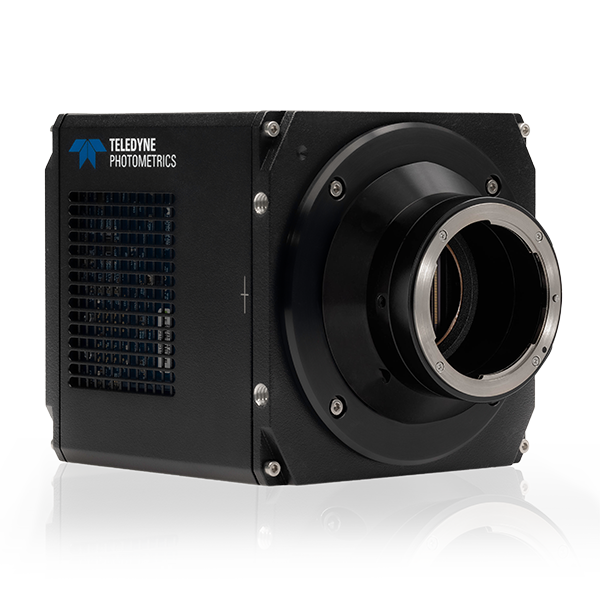
The Kinetix sCMOS camera is an ideal solution for this application, featuring a small pixel for high spatial resolution at low magnifications, a huge 29 mm field of view for large samples, and a Speed mode that can achieve 500 fps across the whole sensor, capturing even the most dynamic samples.
Prof. Siciliano explained his experience with using the Kinetix, “The reason we got the Kinetix was the massive field of view, which is really nice for imaging these massive brain slices, it’s pretty incredible. Generally, we are using the Sensitivity mode, but for our fastest imaging we've also tried the Speed mode, depending on the sensor we're looking at.”
“Overall, the Kinetix is amazing, it's pretty rough going using another camera after using it.”