
Stereo Cameras
FLIR has made stereo vision practical for a variety of research areas by providing hardware and software packages that include complete stereo processing support – from image correction and alignment to dense correlation-based stereo mapping. Stereo vision works in a similar way to 3D sensing in human vision. It begins with identifying image pixels that correspond to the same point in a physical scene observed by multiple cameras. The 3D position of a point can then be established by triangulation using a ray from each camera. The more corresponding pixels identified, the more 3D points that can be determined with a single set of images. Correlation stereo methods attempt to obtain correspondences for every pixel in the stereo image, resulting in tens of thousands of 3D values generated with every stereo image.
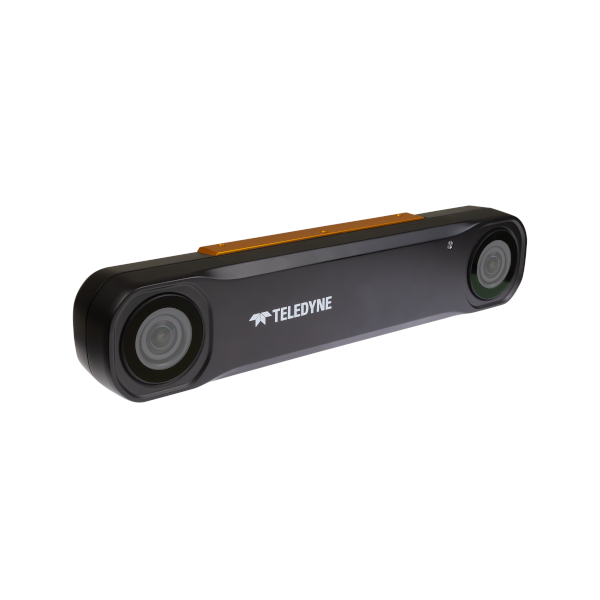

Bumblebee X 5GigE
Dual Path Stereo Camera. Designed for Real-Time Depth and AI Integration.
- Provides real-time 3D depth using Semi-Global Block Matching (SGBM) directly on the camera, or streams 12-bit rectified stereo images for external algorithms, delivering deployment-ready depth and detailed data for advanced applications.
- Delivers 3D depth from 0.5–20 m with millimeter accuracy at 1 m, extending use across diverse applications. FOV models at 60°, 80°, or 105° provide options for the best balance of precision and coverage.
- The low latency makes it ideal for real-time applications such as autonomous mobile robots, automated guided vehicles, pick and place, bin picking, and palletization.