Crystal defect single molecule spectroscopy
Dr. Daqing Wang, Mr Max Masuhr
Nanophysics and Quantum Photonics Group, Institute of Applied Physics, Bonn, germany
Background
Max Masuhr is a PhD candidate in the laboratory of Dr. Daqing Wang at the Nanophysics and Quantum Photonics group at the Institute of Applied Physics in Bonn. Dr. Wang's research explores the fundamental interactions between light and matter at the nanoscale and quantum level, focusing on the precise control and understanding of the interactions of photons with single molecules. With their findings, they aim to unlock new uses of molecules in quantum technologies as well as developing highly sensitive tools for molecular sensing.
One of the experimental methods used on several projects in Dr. Wang’s laboratory consists of exciting single organic defects in a crystalline matrix (2D or 3D) with a laser matching its resonance frequency. The sample’s light emissions are then analyzed with a spectroscopy system, and from the generated spectra the electronic properties of the defects and the surrounding matrix can be investigated, as shown in Fig. 1. Mr. Masuhr mentions, “The spectra from same molecules in a crystal are inhomogeneous, they all get shifted a little bit depending on their specific environments inside the matrices.” This feature makes acquisition challenging due to the degrees of freedom provided by the neighboring lattice. Because of various relaxation mechanisms and the multitude of possible energy states in molecules compared to single atoms, vibrational modes can be observed in the fluorescence spectra, allowing Dr. Wang to hypothesize if the measured signal is in accordance with theory or just a measure of the crystal’s quality.
While spectroscopy can help increase the efficiency of the light-matter interaction, it can also be used to investigate forbidden electronic transitions. One example is Mr. Masuhr’s thesis project, “Using a special laser, I am attempting to turn my molecule from a singlet state into a triplet state, which suddenly makes my molecule magnetic.” The long-lived dark states could potentially be applied for developing a quantum repeater while the magnetic properties could find application in dynamic nuclear polarization.
These mechanisms and the investigated crystal-defect combinations have considerable potential as quantum technologies in different fields such as chemistry and biology, as well as quality assurance in industrial processes.
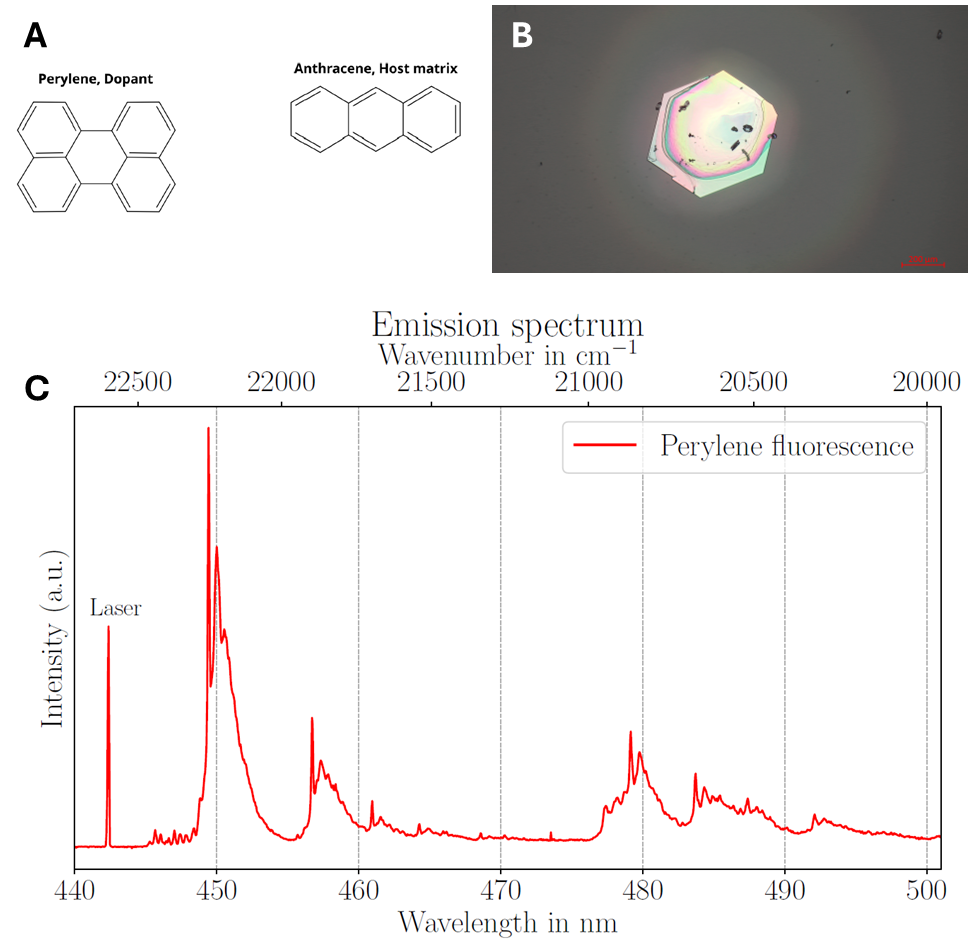
Figure 1: Example of using single molecule spectroscopy to analyse the properties and defects of a crystal sample. A) The crystal sample is a host matrix of anthracene doped with small amounts of perylene. B) An image of the resulting crystal, scale bar 200 μm. C) The resulting fluorescence spectrum, showing distinct energy levels caused by an electronic transition coupled to vibrational and phononic degrees of freedom. Depending on the conditions of the crystal creation, the dopant will have different interactions with the crystal matrix, which can be measured spectroscopically.
Challenge
The experimental method here faces different challenges ranging from sample preparation to hardware requirements. In terms of the sample, the defects introduced into the crystal have slight variations in their signal as the quality of the crystal is never perfect and adds to the vibrational transitions of an electron. Mr. Masuhr comments on this point, “there are phonons around it and if you look at the spectrum, the phonons make the spectrum blurry”.
While the peak width and asymmetry are a measure of the matrix’s quality, to reliably observe electronic transitions in the crystal, the emitted fluorescence needs to be registered with high spectral sensitivity, requiring a specialist spectrometer format. In addition, to detect signals with low intensity the detector also needs to be highly sensitive.
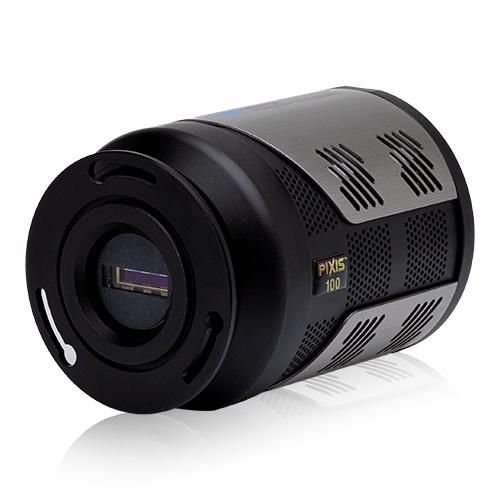
The [PIXIS] camera works great, and the triggering is good. I also like your Lightfield software, especially the real time averaging tool. If you have 1000 exposures, it shows you the signal to noise improving in real time!
Max Masuhr
Solution
The HRS300 spectrograph combined with the PIXIS CCD camera is an excellent solution for Dr. Wang's numerous research projects, where light–matter interactions are observed at the quantum level.
With 1200 l/mm (750 blaze) and 600 l/mm (500 blaze) gratings on the HRS300, a good compromise between spectral resolution and detection range is reached. The HRS300 spectrograph also offers high spectral resolution and flexibility, paramount features to observe small differences between spectra, especially when doing vibrational spectroscopy.
The PIXIS CCD camera is actively cooled, combining low read noise with high quantum efficiency for highly sensitive imaging, especially useful when acquiring low intensity signals such as those generated through phosphorescence. Finally, the Lightfield software package from Teledyne Princeton Instruments streamlines data acquisition and data analysis with a user-friendly interface. The combined software and hardware solution enables to efficiently acquire, visualize and process complex spectral data.

Learn More About The SPECTRAPRO HRS