High-Speed Cardiac Voltage Imaging
Dr. Ewan Fowler
Sir Sir Martin Evans Building, Cardiff University, UK
Background
Dr. Ewan Fowler is a British Heart Foundation Basic Sciences Intermediate Research Fellow at Cardiff University, working to understand heart disease, specifically arrhythmias and the role that calcium handling has on cardiac electrophysiology. Dr. Fowler told us more, "I'm currently working with a model of inherited heart disease called CVPT [catecholaminergic polymorphic ventricular tachycardia], where it's thought that increased spontaneous calcium release can trigger ectopic activity in the heart."
"We mainly use imaging for optical mapping of calcium and voltage sensitive dyes in intact, isolated hearts to try and understand how arrhythmias originate and propagate, and whether novel therapies are effective at suppressing these."

Figure 1: Fluorescence recording of a perfused mouse heart labelled with the voltage sensitive indicator di-8-ANEPPS and images at 900 fps (top, left). Electrical stimulation at the apex elicited a rapidly propogating wave of activation across the ventricular epicardium occuring in <20 ms (top, middle). The duration of action potentials showed regional variation in a base-to-apex manner (top, right). Optical action potentials were analysed on a pixel-by-pixel basis from the change in dye fluorescence upon tissue depolarization (middle panel). Phase mapping techniques were used to identify rotor-like patterns of re-entry during ventricular arrhythmias (bottom). Data acquired using the Kinetix22 sCMOS with MicroManager software, analysed using ElectroMap.
Challenge
Dr. Fowler also went over the challenges he faces with this application, "We need a living heart preparation that is then loaded with voltage or calcium sensitive dyes, and then we image the epicardium of the left ventricle. The heart needs to be perfused and oxygenated, and we need to arrest the heart to stop beating and avoid motion artifacts."
"When imaging we have a trade-off between temporal and spatial resolution, to record action potentials from mouse hearts we need to be recording at around one kilohertz [1000 fps], but we also want to get more detail about the complex dynamics involved in activating the ventricle, so we need sufficient spatial resolution too."
"The voltage sensitive dyes don't produce a huge change in fluorescence when activated so the dynamic signal we get is very low. For stochastic events like fibrillation, it's not possible to perform averaging, so this means we need to minimise noise as much as possible."
The Kinetix22 was great, we could get images straight away and access all of the parameters we needed, no problem at all.
Dr. Ewan Fowler
Solution
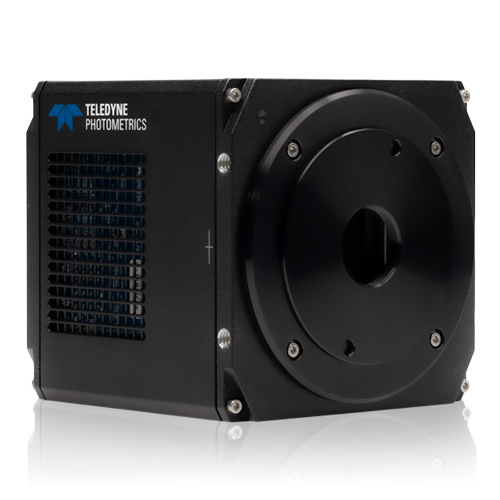
The Kinetix22 CMOS camera is an ideal solution for voltage imaging, featuring high sensitivity, high speeds and a large sensor. Dr. Fowler described his experience with the Kinetix22, "We're imaging with a 4x4 bin in the 12-bit Sensitivity mode at very high speeds, and it's enough to image the whole surface of the heart."
"The next thing we want to do is dual calcium and voltage imaging simultaneously using an image splitter, so we can expand the Kinetix22 region horizontally to get both images."