Space Imaging with Hermetically Packaged Linear InGaAs
Kai Song, Jih-Fen Lei, Anders Peterson, Henry Yuan, Jongwoo Kim, Joe Kimchi, Vincent Douence, Brian Starr, Venkataraman Sundareswaran, James W. Beletic
Teledyne Judson Technologies
Background
Teledyne Judson Technologies (TJT) has developed a flight-grade 13 µm pixel pitch 6000-element InGaAs linear array in a hermetic package, targeting space remote sensing and high-resolution imaging applications. InGaAs is the material of choice for short-wave infrared (SWIR) imaging because of its sensitivity in the 1.0-1.7 µm range, low cooling requirements, and mature fabrication processes. Large linear arrays enable push-broom instruments without scanning mirrors, simplifying system design and reducing cost. Historically, large linear arrays were constructed by butting multiple smaller arrays together. This work pushed the state-of-the-art by realizing a monolithic 13 µm pitch 6000-element linear array, hermetically sealed and nitrogen back-filled for high reliability, suitable for integration on space payloads.
Challenge
Constructing a continuous 6000-element linear array with 13 µm pixels posed multiple challenges. The array needed to maintain high operability and uniformity while minimizing dark current and achieving high quantum efficiency. Small pixel size and long array length (approximately 87 mm) required careful control of the epitaxial growth and planar junction formation to reduce surface and perimeter effects. The detector also had to be compatible with a custom 2 Me- capacitance trans-impedance amplifier (CTIA) readout integrated circuit (ROIC) offering four gain settings and readout modes, all while being packaged in a hermetic enclosure with flat optical surfaces.
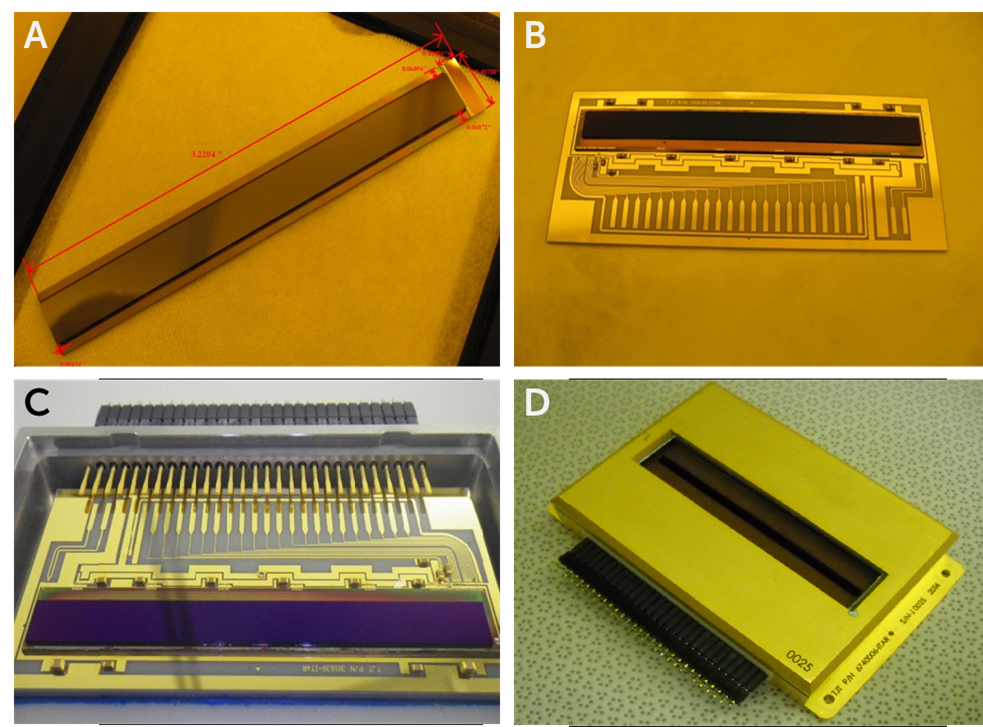
Figure 1: Images of the TJT 6000x8 element array. A+B) Chip before (A) and after (B) mounting on custom patterned ceramic motherboard wutg sensor chip assembly (SCA). C+D) 6000x8 element assembly package pre-cap (C) and post seal (D).
Solution
The array was fabricated from 100 mm (4-inch) InGaAs wafers grown by metal-organic chemical vapor deposition (MOCVD) on InP substrates. The epitaxial structure included an N⁺ InP buffer, lightly doped n-InGaAs absorption layer, and an N-InP cap layer. P⁺ regions were formed by Zn diffusion through the cap layer, producing a planar P⁺-n-N⁺ junction. Detector die sizes were 79.3 mm × 6.8 mm, with the 6000×8 pixel format providing eight rows to allow substitution of defective pixels. Performance evaluation chips (PECs) were patterned around the wafer for characterization of dark current, quantum efficiency, and surface/perimeter effects.
The sensor chip assembly (SCA) was constructed by hybridizing the InGaAs detector to a matching ROIC, then mounting and wire bonding the hybrid to a patterned ceramic motherboard. Peak-to-valley surface flatness of the hybrid was maintained below 2 µm to ensure minimal impact on imaging quality. The hermetic package incorporated a Kovar single in-line header with 29 vacuum feedthrough pins, a back-filled dry nitrogen environment, an anti-reflection (AR) coated sapphire window, and an optical slit with an f-number of 3.0. Flatness of the window was kept below 1 µm peak-to-valley to preserve optical performance.
Results
Testing of the fully packaged array demonstrated excellent electro-optical performance. Dark current was measured at less than 3.5 fA per 13 µm pixel at 22 °C. Quantum efficiency exceeded 80% at the peak wavelength of 1.58 µm and remained above 50% across 1.0 µm to 1.68 µm. The array exhibited a pixel full well capacity greater than 2 Me-, read noise below 600 e-, and an SNR of 1129 at 90% well fill. The ROIC supported read-while-integrating operation across four gain settings, and two 14-bit uni-encoded LVDS outputs enabled high-speed data readout at up to 16 MPix s⁻¹. Pixel operability was greater than 99.95% without noise and exceeded 95% when including read noise. Power consumption at 1 kHz frame rate was under 500 mW, with supply voltage of 3.3 V ± 10%.
Conclusion
Teledyne Judson Technologies successfully developed a monolithic 6000×8 element InGaAs linear array with 13 µm pixel pitch and integrated it into a high-reliability hermetic package. The sensor exhibits ultra-low dark current, high quantum efficiency, and high operability, supporting high-speed, low-noise imaging in the 1.0 µm to 1.68 µm range. The robust packaging, precise SCA flatness, and AR-coated window enable reliable performance in space remote sensing and other demanding imaging applications. The array demonstrates the capability to operate at 1 kHz frame rates with integration times near 1 ms, making it suitable for commercial imaging, scientific, and aerospace missions.
Read the original published article here:
Development of a hermetically packaged 13μm pixel pitch 6000-element InGaAs linear array
Kai Song, Jih-Fen Lei, Anders Peterson, Henry Yuan, Jongwoo Kim, Joe Kimchi, Vincent Douence, Brian Starr, Venkataraman Sundareswaran, James W. Beletic
Abstract
In this paper, we present the test results of a flight-grade 13μm pixel pitch 6000-element 1.7μm InGaAs linear array in a hermetic package, designed and developed for space remote sensing and imaging applications. The array consists of a single 13μm pixel pitch 6000-element InGaAs linear array and a custom single digital 2.0 Mecapacitance trans-impedance amplifier (CTIA) readout integrated circuit (ROIC) with four gains. We have achieved greater than 80% peak quantum efficiency and higher than 1100 signal-to-noise ratio (SNR) at 90% well fill. The focal plane array is in a vacuum hermatically sealed package with an anti-reflective (AR)-coated Sapphire window and 29 pins, including four for low voltage differential signaling (LVDS) outputs.
Reference
Kai Song, Jih-Fen Lei, Anders Peterson, Henry Yuan, Jongwoo Kim, Joe Kimchi, Vincent Douence, Brian Starr, Venkataraman Sundareswaran, and James W. Beletic (14 May 2018) Development of a hermetically packaged 13μm pixel pitch 6000-element InGaAs linear array, Proc. SPIE 10656, Image Sensing Technologies: Materials, Devices, Systems, and Applications V, 106560K; https://doi.org/10.1117/12.2305374