Live Mouse Brain Vascular Imaging
Dr. Thomas Broggini
Translational Neurosurgery Laboratory, University Clinic Frankfurt, Germany
Background
Dr. Thomas Broggini is a principal investigator at the Translational Neurosurgery Laboratory at the University Clinic Frankfurt. His research focuses on investigating and understanding the mechanisms of relevant neurosurgical diseases, leading to the development of potential treatments. Dr. Broggini's underlying goal is to unravel the complexities of the brain and its diseases. To tackle these challenges, he uses an interdisciplinary approach combining cutting edge sample preparation methods, different types of microscopy and image processing/analysis pipelines.
In one of his recent projects, Dr. Broggini states, “We are looking at the oscillation of the vascular system in pathology using a widefield microscopy system with a photography objective, this setup lets us image a whole mouse cortex. The living mouse has a cranial window introduced into the head... allowing us to monitor brain activity in vivo through imaging fluorescence.”
By illuminating sequentially with three different LEDs and using a multiband filter, three channels can be imaged simultaneously. The first channel images the vibrations of the vascular system (using GCaMP as marker), the second one monitors the neuronal activity (using jRGECO) and the third channel can be used for imaging hemodynamic changes, as seen in Fig.1 below.
Dr. Broggini further mentions, “Through image processing, the intensity of the vascular oscillations can be linked to the neuronal activity. The acquired images are analyzed to extract relevant vascular information from the raw data, by Fourier transforming the signal of the GCaMP channel we obtain power densities”.
Through autocorrelation of the signal over time, the vasomotor contractions can be identified as a power peak at a frequency of ~0.1 Hz. Through this cutting-edge approach, the effects of pathologies on the brain’s nervous and vascular systems are studied and understood.
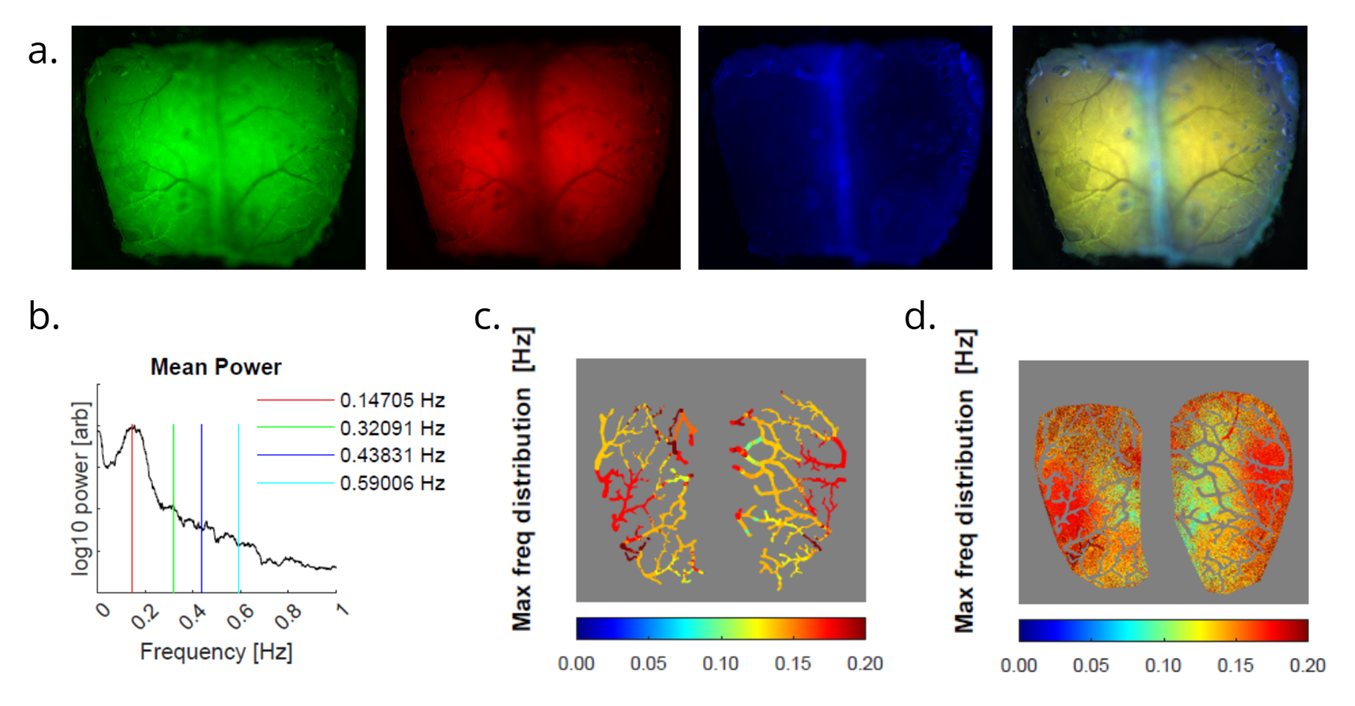
Figure 1: Cortical widefield images of a full mouse brain. a) Interleaved imaging shows the vascular system with SMC-GCaMP8.1 (green), the neuronal activity jRGECO (red) and the hemodynamic correction (blue). Right image represents the merged channels. b) Frequency analysis of the vascular segments shows average vascular activity ~0.1 Hz. c) Spatial analysis of the signal reveals individual sub segments of different maximum frequencies in the vascular tree. d) The underlying low frequency neuronal activity is spatially corresponding to the vascular activity, hence entraining the vascular activity. Images acquired with the Kinetix sCMOS camera.
Challenge
Dr. Broggini described his imaging challenges, “The acquisition of a full mouse brain through fluorescence using a lower NA objective provides comparatively low signals”.
The detector thus needs to combine a high sensitivity sensor with a large field of view. Furthermore, the processes that are observed here are dynamic, requiring an appropriate temporal resolution from the detector. The sequential acquisition of fluorescence images of up to three different channels is only possible with a reliable electronical triggering of the light source and a detector matching its acquisition to the triggering signal. With up to three channels simultaneously, the quantum efficiency of the camera needs to be high across the visible wavelength spectrum.
With the Kinetix I am really a fan of the extraordinary sensitivity, being able to choose between PCIe and USB, and s the simple triggering with the BNC connector.
Dr. Thomas Broggini
Solution
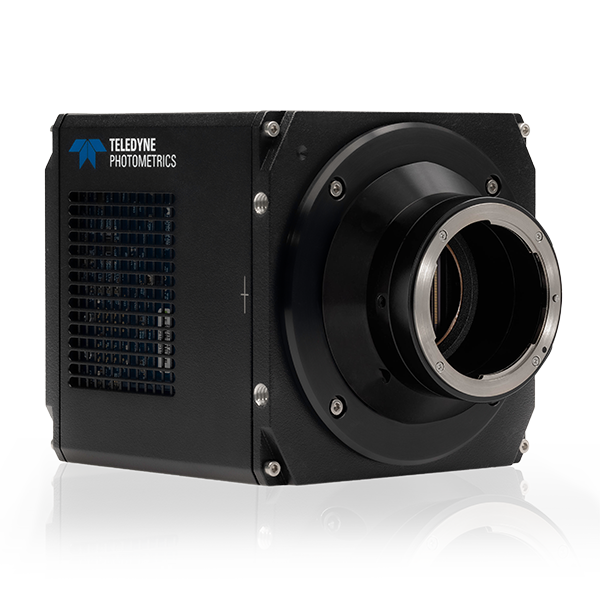
The Kinetix sCMOS camera is an ideal solution for this application, as it allows Dr. Broggini to image large fields of view with high sensitivity and high temporal resolution.
In this note, the vasomotor peak (with a frequency of around 0.1 Hz) can effortlessly be resolved by acquiring images with 66ms acquisition time, resulting in a 5 Hz imaging frequency for each of the three imaging channels. This can be achieved with the high sensitivity mode of the Kinetix resulting in high signal to noise ratio due to the combination of high quantum efficiency and low noise. The Kinetix still provides opportunities to shift focus onto faster dynamic processes in future experiments if required. The whole custom system is steered using MicroManager, an open-source software tool for controlling different hardware parts. The triggering of the LED illumination with the camera acquisition is made easy with the BNC connectors and the documentation provided.