3D Light Sheet Organoid Imaging
Prof. Miao Ping Chien and Dr. Jelle Storteboom
Department of Molecular Genetics, Erasmus University Medical Center, Rotterdam, netherlands
Background
Prof. Miao Ping Chien’s laboratory at the Erasmus University Medical Center is exploring the molecular mechanisms behind rare and aggressive cancer cell subpopulations, as well as cancer cell states that contribute to the tumor progression, metastasis and therapy resistance. Their multidisciplinary approach uses a combination of microscopy, AI-assisted image analysis, bioinformatics, as well as single cell and spatial-omics technologies. This aims to translate findings on the cellular level to clinical applications.
Dr. Jelle Storteboom is a researcher in Prof. Chien’s group with a specific focus on imaging. To analyze single cancer cells with irregular phenotypes, he tracks them using widefield microscopy, photoactivates them, and separates them for single cell sequencing. This approach aims to link specific phenotypes to their origins at the DNA and RNA level. Dr. Storteboom is also implementing a selective plane imaging setup based on the ASI swept confocally aligned planar excitation (SCAPE) system. This allows for high throughput imaging of 3D samples, supplementing the screening methods in the laboratory and enabling the extension of research into samples such as tissues and organoids where cells are in a more biologically relevant environment, closer to the one found in vivo within organisms.
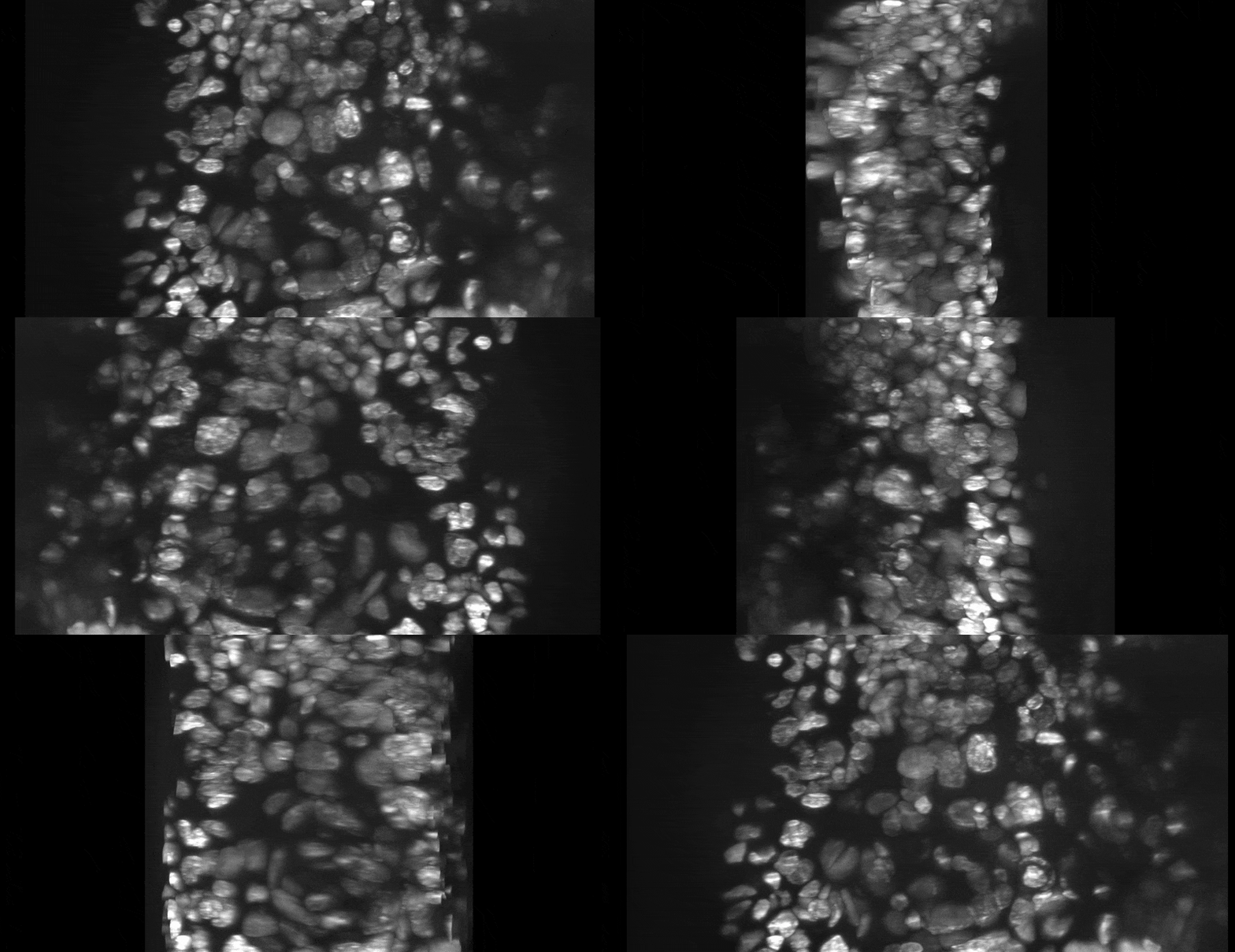
Figure 1: Patient-derived slice of tissue (~300 µm thick) from a head and neck cancer. The volume consists of 500 images with 300 nm spacing, integration time on the Kinetix22 for a single image was 100 ms. Sample was stained with SPY650 as a live cell DNA stain (with 638 nm excitation). Acquired with the Kinetix22 sCMOS camera.

Figure 1: Patient-derived organoid composed of esophagus cancer cells. The volume consists of 300 images with 200 nm spacing, integration time on the Kinetix22 for a single image was 20 ms. Sample was stained with SPY650 as a live cell DNA stain (with 638nm excitation). Acquired with the Kinetix22 sCMOS camera.
Challenge
The imaging of 3D volumes often creates large amounts of data, as the final superstructure is composed of the single images. Cell movement between two subsequent images can create artifacts and to minimize it, the detector must operate at a certain acquisition speed. The final images also are assembled by an algorithm to accurately reproduce the imaged ultrastructure. This requires a robust, reproducible acquisition system and a reliable electronic connection between the different hardware parts of the setup. A highly sensitive detector is also needed to minimize the contribution of noise and maximise the overall signal-to-noise ratio (SNR), ensuring that the algorithm can reliably identify select image features.
Furthermore, live cell applications are improved by minimizing phototoxicity. One approach is to limit sample illumination which results in a restricted fluorescence photon budget and lower signal levels, this method can only be done with a high sensitivity sensor.
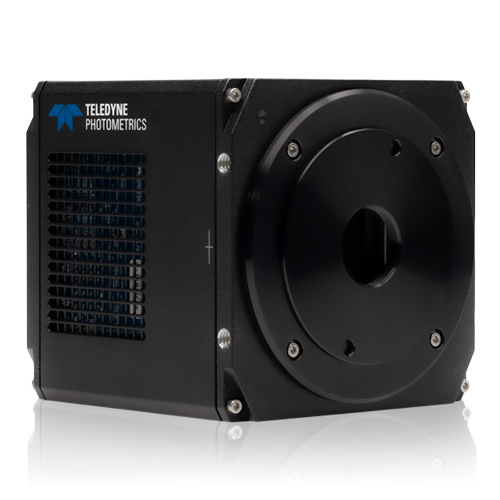
We’re happy with the [Kinetix22] camera. The speed is important for acquiring 3D light sheet data with our SCAPE system.
Prof. Miao Ping Chien
Solution
For selective plane illumination and SCAPE applications, the Kinetix22 is a powerful, flexible and reliable addition to this imaging system. The high quantum efficiency and the minimal read out noise are ideal for fast and sensitive imaging samples while minimizing photodamage. The Speed Mode of the Kinetix22 allows for easy capture of dynamic processes with high temporal resolution.
For this project, a high imaging throughput is crucial to resolve volumes, as a single 3D structure can be composed by up to 400 images. Alongside speed and sensitivity, the large field of view of the Kinetix22 enables imaging a whole population of cells or organoids with a sub-cellular spatial resolution. Finally, the Kinetix22 can be controlled with the MicroManager software as well as custom Python scripts, accommodating for different open-source custom software solutions.