Progress in Extended InGaAs Photodetectors
Henry Yuan, Jiawen Zhang, Jongwoo Kim, David Bond, Joyce Laquindanum, Joe Kimchi, Mary Grace DeForest
Teledyne Judson Technologies
Background
InGaAs and HgCdTe (MCT) remain the two principal materials for short-wavelength infrared (SWIR) photodetectors in the 1-3 µm spectral range. Standard lattice-matched InGaAs detectors with a 1.67 µm cutoff are widely used, but there is a growing demand for extended wavelength (EW) InGaAs photodetectors with cutoffs ranging from 1.9 µm to 2.6 µm. These detectors enable advanced capabilities in applications such as thermal and gas sensing, industrial spectroscopy, food safety monitoring, and emerging Internet-of-Things (IoT) devices.
Although EW InGaAs technology has been under development for nearly three decades, it historically exhibited higher dark current and lower resistance-area product (R₀A) than comparable MCT detectors at the same cutoff wavelength and operating temperature. According to Tennant’s Rule 07 model, which predicts state-of-the-art MCT performance based on cutoff wavelength and temperature, EW InGaAs typically underperformed, with the performance gap increasing for longer cutoff wavelengths and lower temperatures. This limitation was primarily due to lattice mismatch between the InGaAs absorber and the InP substrate, which introduced dislocations and defect-related leakage currents.
Teledyne Judson Technologies (TJT) has been a key developer and supplier of EW InGaAs detectors, producing frontside-illuminated, planar P-on-n devices in discrete single-element or linear array formats. These devices, typically 1-3 mm in diameter, have continued to improve through advances in epitaxial growth, material engineering, and surface passivation.
Challenge
The central challenge in extending the wavelength range of InGaAs detectors is the degradation in performance associated with increasing indium content. As the cutoff wavelength approaches 2.6 µm, lattice mismatch between the InGaAs absorber and the InP substrate increases significantly, leading to defect generation, reduced minority carrier lifetime, and elevated dark current. These effects become even more pronounced at lower temperatures, where defect-related leakage mechanisms such as generation–recombination (g–r) current and trap-assisted tunnelling dominate.
Surface and interface defects present an additional limitation, contributing to surface leakage currents that degrade shunt resistance (R₀) and overall detector performance. Early experiments with gate-controlled diodes demonstrated that applying a negative gate bias could suppress surface leakage, indicating that defect-related charges were present at the surface and contributed significantly to dark current. These issues combined to keep EW InGaAs performance below that of MCT as defined by Rule 07, especially for longer cutoff wavelengths and cooled operation.
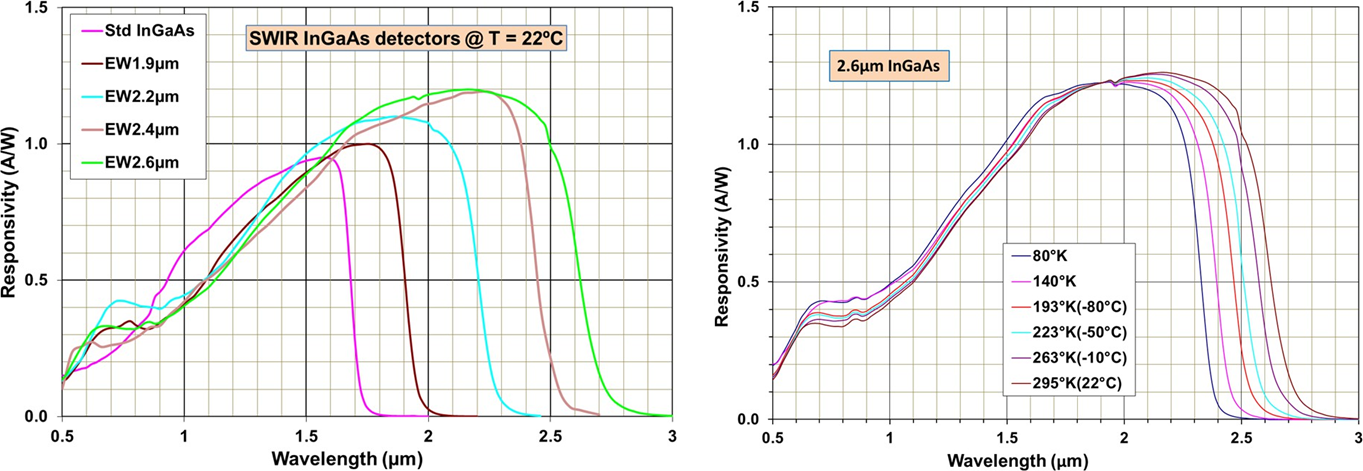
Figure 1: InGaAs detector spectral responsivity. The left graph shows responsivity at room temperature for various cutoff wavelengths, and the right graph shows 2.6 µm responsivity at various temperatures.
Solution
Recent advances in EW InGaAs growth and fabrication at TJT have focused on reducing defect density, extending carrier lifetimes, and minimising leakage currents. Improvements include optimisation of epitaxial growth conditions to reduce dislocations, advanced surface passivation techniques to suppress interface states, and refinements to device processing to enhance junction quality and reduce shunt pathways.
These innovations have led to substantial increases in material quality and detector performance. Surface passivation improvements, in particular, have proven crucial to minimising perimeter leakage, while careful control of diffusion and layer interfaces has enhanced carrier transport and reduced defect-related recombination. Together, these changes have enabled EW InGaAs devices to approach their fundamental performance limits, bringing them into direct competition with MCT detectors across a wide range of operating conditions.
Results
The cumulative impact of these process enhancements has been a dramatic improvement in detector characteristics. R₀A values have increased by factors of 3-5× in typical production runs and up to 10-100× in the best-performing lots. For example, at a 2.54 µm cutoff and 1 mm diameter, R₀A improved from approximately 5 Ω·cm² to 50 Ω·cm², while at 2.1 µm it rose from 2 × 10³ Ω·cm² to 1 × 10⁴ Ω·cm².
Temperature-dependent measurements highlight the scale of these gains. For 2.6 µm devices, R₀A improved by ~10× at room temperature, ~20× at -20 °C, ~30× at -40 °C, and ~100× at -65 °C. Many devices now meet or slightly exceed Rule 07 predictions across the full temperature range. Diffusion current limits improved by ~13× and g-r current limits by ~87×, corresponding to increases in minority carrier hole lifetime from ~1.9 ns to ~307 ns and in Shockley–Read–Hall recombination lifetime from ~54 ns to ~4.7 µs.
Dynamic resistance now matches or surpasses that of equivalent MCT devices. Average R₀ for 2.54 µm detectors reached ~60 kΩ at room temperature, ~3 MΩ at -20 °C, ~25 MΩ at -40 °C, and ~400 MΩ at -65 °C. At a 2.1 µm cutoff, typical devices achieved ~1.5 MΩ at room temperature. Analysis of dark current versus perimeter-to-area ratio shows minimal surface leakage in devices larger than 0.25 mm, with a bulk current density (J_B) of 121.2 µA·cm⁻² and a surface current component (J_s) of 68.7 nA·cm⁻¹. Wafer-scale uniformity has also improved, with ~90% of devices exceeding the Rule 07 benchmark on a representative wafer and an average R₀ of 53.5 kΩ.
Conclusion
The performance of extended wavelength InGaAs photodetectors has advanced dramatically in recent years, closing (and in some cases eliminating) the historical gap with MCT-based devices. Improvements in epitaxial material quality, defect reduction, and surface passivation have led to substantial gains in carrier lifetime, dark current suppression, and dynamic resistance. Across a wide range of cutoff wavelengths (1.9-2.6 µm), detector sizes, and operating temperatures, EW InGaAs devices from TJT now achieve performance that meets or exceeds Rule 07 predictions.
For example, 2.6 µm detectors now exhibit R₀ improvements of up to 100× at -65 °C and carrier lifetime enhancements exceeding two orders of magnitude. These results establish EW InGaAs as a competitive and often superior alternative to MCT for many SWIR applications, particularly where scalability, manufacturability, and cost are critical considerations. Continued process refinements are expected to further improve performance and reliability, ensuring that EW InGaAs will play an increasingly central role in next-generation infrared sensing systems.
Read the original published article here:
Recent progress in extended wavelength InGaAs photodetectors and comparison with SWIR HgCdTe photodetectors
Henry Yuan, Jiawen Zhang, Jongwoo Kim, David Bond, Joyce Laquindanum, Joe Kimchi, Mary Grace DeForest
Abstract
This paper reviews recent progress in extended wavelength (EW) InGaAs photodetectors (1.9-2.6µm cutoff) at Teledyne Judson Technologies (TJT). Up to recent years, EW InGaAs detectors had generally exhibited higher dark current than the corresponding short-wavelength infrared (SWIR) HgCdTe per Rule 07 for the same cutoff wavelength and operating temperature. The performance gap between the two materials became larger as the cutoff wavelength (operating temperature) increases (decreases). The recent progress in EW InGaAs technology, however, has resulted in a remarkable improvement of EW InGaAs detector performance. The performance gap is now becoming much smaller at some wavelengths, while at other wavelengths, EW InGaAs even slightly exceeds Rule 07. We present recent detector performance data taken from TJT EW InGaAs production line database. These discrete detectors are frontside-illuminated and have relatively large sizes of 1-3mm diameter. Detector dark current and dynamic resistance improved by up to 10- 100X in some cases, and by at least 3-5X in other cases, when compared to TJT catalog typical specifications. This performance improvement has been achieved for all cutoff wavelengths, detector sizes and operating temperatures of interest.
Reference
Henry Yuan, Jiawen Zhang, Jongwoo Kim, David Bond, Joyce Laquindanum, Joe Kimchi, and Mary Grace DeForest (12 September 2019), Recent progress in extended wavelength InGaAs photodetectors and comparison with SWIR HgCdTe photodetectors, Proc. SPIE 11129, Infrared Sensors, Devices, and Applications IX, 111290E (12 September 2019); https://doi.org/10.1117/12.2532418