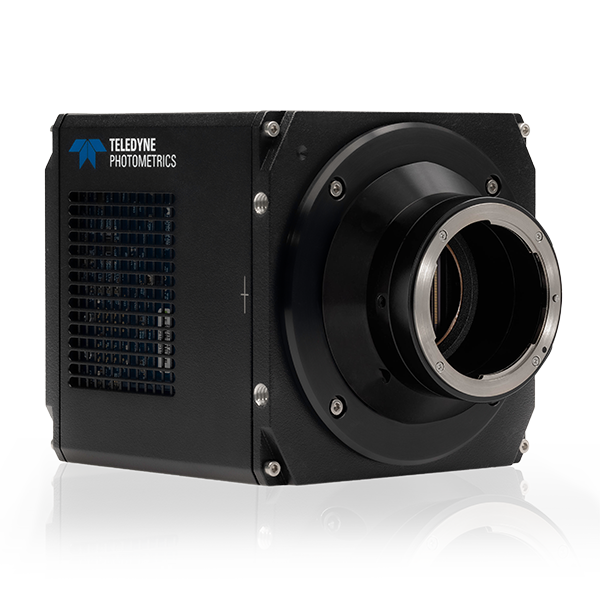
Kinetix Advanced Features: Multi-ROI
Dr. Matthew Köse-Dunn
Teledyne Photometrics
Introduction
Modern scientific cameras capture data across increasingly large sensors. For example, the Kinetix sCMOS camera has a 29.4 mm sensor, able to capture vast cell networks, entire tissues, or constellations in the night sky.
However, in many experiments researchers are only interested in specific regions of the sensor, such as imaging discrete clusters of cells or long thin samples. This is a common feature when imaging and is referred to as a region of interest (ROI), a user-selectable portion of the sensor that determines which pixels to read out. Instead of acquiring from the full sensor, the camera reads and outputs just the defined region.
Establishing a ROI reudces the size of the resulting image file and allowing for finer experimental control in software. Additionally, part of the inherent advantage of using sCMOS cameras is the ability to increase imaging speed when establishing a ROI: the fewer rows in the image, the faster the camera can acquire. For example, while the Kinetix can acquire at 82 frames per second (fps) across the full frame (3200 x 3200 pixels) in Dynamic Range mode, by defining a ROI across half the sensor (1600 x 3200), the speed is doubled to 164 fps. This continues until the camera is imaging at 1000s of fps at very small array sizes only a few rows high.
While a single ROI is a useful experimental tool, what if your scientific application requires multiple separate regions, anywhere on the sensor? This article introduces multi-ROI, a feature available on the Kinetix family of cameras.
Multi-ROI
Multi-ROI (henceforth referred to as mROI) can be implemented in several ways, but some typical mROI implementations run into the ‘bounding box’ issue, as explained in Fig.1. Essentially, if your ROIs are many rows apart, typical mROI captures all the rows in between the ROIs, negating the file size and speed benefits.
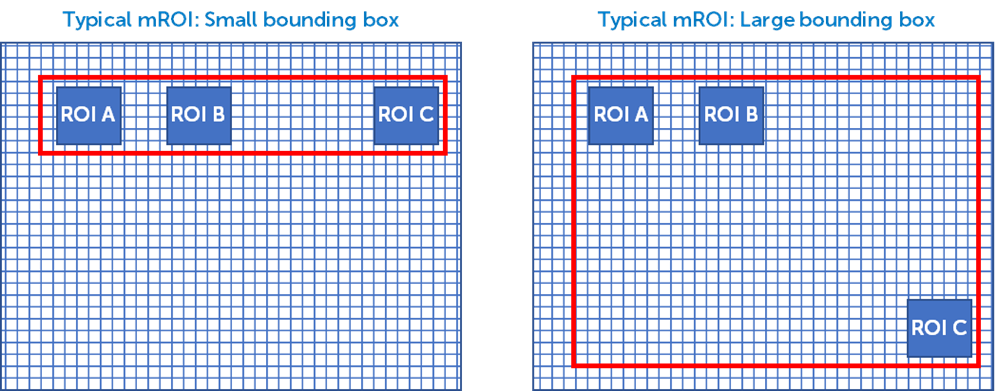
Figure 1: Typical mROI and the bounding box issue. On the left hand image, three ROIs (A, B, C) are selected on the same row, the camera will read out from the red area, a small bounding box with great speed and file size benefits. However, if the ROIs are many rows apart, as in the right hand image, ROI C results in a large bounding box, where the camera is reading out virtually the entire sensor, negating any benefits to establishing these ROIs.
However, the Kinetix has a powerful on-board FPGA processor and can natively run its own, more intelligent version of mROI which solves the bounding box issue.
Kinetix Multi-ROI
The Kinetix family of cameras implement mROI directly in the front-end firmware, deciding how to read ROIs and optimize performance. The implementation of Kinetix mROI is outlined in Fig.2.
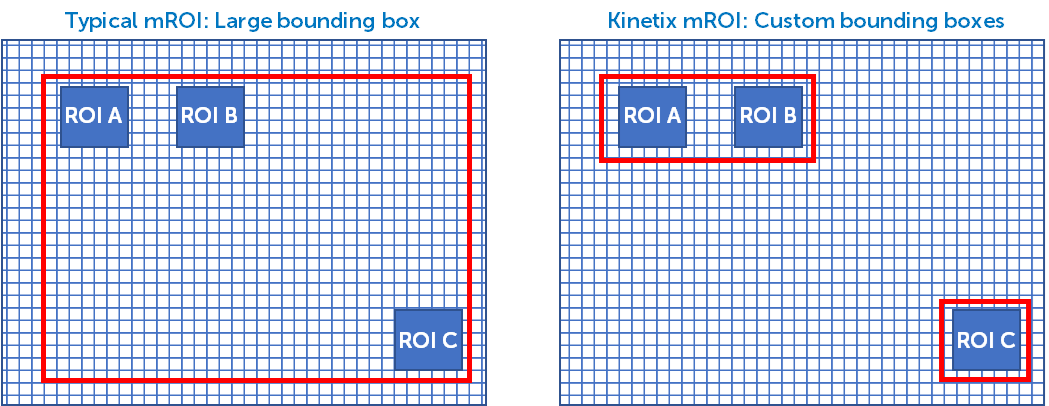
Figure 2: Kinetix mROI solves the bounding box issues by capturing regions in separate frames and merging them into a single frame. While the left hand image has to read out the entire sensor, the right hand image shows how Kinetix mROI can read out only the selected ROIs, resulting in significantly smaller file sizes and faster acquisition speeds.
When establishing multiple ROIs with a Kinetix, it will intelligently read out the regions for maximum performance, based on exposure time and the size/location of the ROIs:
- If the ROIs are close, adjacent, or overlapping, the Kinetix will use standard single frame readout for efficiency, same as legacy mROI implementations
- If the ROIs are far apart and there is a speed benefit available, instead of reading a large bounding box the Kinetix captures ROIs in multiple frames and presents a single merged frame to the imaging software
This hybrid approach ensures optimal imaging performance regardless of ROI placement.
For example (shown in Fig.3), the Kinetix in Dynamic Range mode can read out the full frame in 82 fps. If two ROIs of 512 rows each are established, one at the top of the sensor and one at the bottom, typical mROI would read out the two ROIs and all the rows in between, equivalent to reading out a full frame, and achieve 82 fps: no speed benefit.
However, with Kinetix mROI, only the top 512 and bottom 512 rows are captured, resulting in a speed of 250 fps, a marked improvement over the native 82 fps.

Figure 3: Typical mROI read out the two ROIs at 82 fps, the same as the native frame time. Kinetix mROI reads out the two ROIs at 250 fps by skipping the rows inbetween, also reducing file size.
Kinetix mROI results in significantly higher frame rates even with multiple, separate ROIs. This reduces data loads, lowering storage and processing requirements, and allows for more flexibility and diverse experimental designs. Users can monitor multiple channels or organisms at once.
Applications
Kinetix mROI unlock new experimental possibilities, including:
- Parallel monitoring of spatially distinct processes
- Functional imaging of multiple brain regions/neural networks
- Acquiring from specific spectral bands
- Recording from multiple channels of microfluidic devices
A number of applications result in samples with discrete positioning across the sensor, such as light field imaging or single molecule imaging. For these applications, any sample that is confined to certain areas of the sensor, can benefit from Kinetix mROI.

Figure 4: Applications that can benefit from Kinetix mROI. The top image is a whole nematode brain, with mROI multiple nematodes can be imaged at once at higher speeds, as the sample is long/thin and will fit within only a few rows on the Kinetix. The centre image shows actin fibres, with mROI data from select fibres can be acquired at higher speeds without having to capture background or other elements. The bottom three images all show samples with channels, typically microfluidic devices with flow, here mROI can be used to acquire data from just the channels where samples flow, ignoring the empty spaces in between.
Limitations
The current version of Kinetix mROI is subject to the following limitations:
- Currently only available on Kinetix Family cameras
- Requires firmware version 30.45.00 or higher
- Currently only available in the 16-bit Dynamic Range mode
- Currently only available with internal triggering modes, external triggering methods are affected by the frame-splitting logic
- Level triggering is not supported
- Metadata must be enabled
Imaging while keeping these limitations in mind will result in the optimal performance and best imaging experience.
Conclusion
With Kinetix mROI, researchers are no longer forced to choose between frame rate and spatial coverage. By intelligently handling ROI readout at the firmware level, Kinetix sCMOS cameras deliver best-in-class speed, flexibility, and efficiency for demanding scientific imaging applications.
This breakthrough feature empowers users across life sciences, physical sciences, and astronomy to see more, faster, and smarter.